

Small boutiques curate collections by defining a clear editorial niche, splitting inventory across core bestsellers, trend-driven pieces, and experimental items, then refining that mix through ongoing customer feedback. This process, known in retail as assortment planning, is the engine behind every successful independent shop. Done well, it builds the kind of customer trust that no mass retailer can replicate. Wildflowerwardrobe applies exactly this discipline to its women’s fashion offering, proving that how small boutiques curate collections is as much a business practice as it is a creative one.
How small boutiques curate collections through inventory allocation
The most practical starting point for any boutique buyer is the 60/30/10 inventory split. Sixty percent of the budget goes to core bestsellers, thirty percent to trend-driven items, and ten percent to new or risky test pieces. This structure keeps cash flow predictable while leaving room for fresh ideas.

Within those three buckets, category-level budgeting adds another layer of control. A typical breakdown looks like this:
| Category | Budget share |
|---|---|
| Tops | 25% |
| Denim | 20% |
| Dresses | 15% |
| Layering | 15% |
| Accessories | 15% |
| Test/new pieces | 10% |
Category budgeting aligned to actual sales trends prevents overbuying in slow categories and underbuying in high-demand ones. A boutique that stocks too many dresses and not enough tops will feel the cash squeeze within a single season.
The 10% test allocation is where curation gets interesting. This is the slot where a buyer can try a new silhouette, an emerging label, or a color story that feels right but has no sales history to back it. Keeping it capped at ten percent limits the downside if the test fails. It also creates a built-in feedback loop: if a test piece sells out fast, it earns a spot in the thirty percent trend tier next season.
Pro Tip: Track sell-through rates by category every four weeks. If a category consistently sells below 60% in that window, cut its budget share next cycle and redirect funds to what is moving.
Tops and denim typically carry the largest budget shares because they drive the most repeat purchases. A customer who loves a boutique’s denim selection will return for the next wash or cut. That repeat behavior is the foundation of building a trend-proof wardrobe for your customers and a reliable revenue base for the shop.
How do boutiques define and maintain a clear editorial niche?
A boutique’s editorial niche is its point of view. It answers the question: “Why would a customer choose us over anyone else?” The answer lives in the labels a buyer selects and the way those labels are presented together.
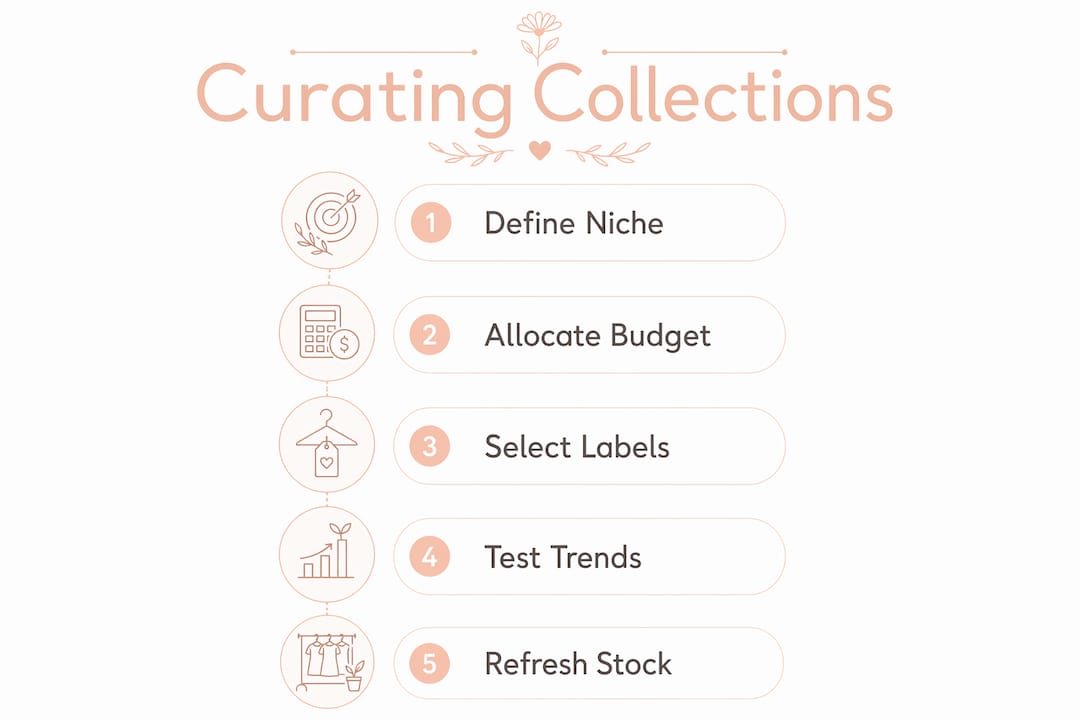
Boutiques with the strongest editorial fit select labels that add unique value without contradicting the store’s existing style. They treat designer relationships as long-term investments, not seasonal transactions. A vendor who understands your customer and ships consistently is worth far more than a trendy label that delivers late and returns poorly.
Carrying fewer labels deepens that understanding. Fewer than 20 core labels allows a buyer to know each brand’s sizing quirks, quality standards, and customer appeal in detail. That knowledge translates directly into better buying decisions and stronger product storytelling on the floor or on a product page.
Product storytelling is the part most boutiques underinvest in. A dress is not just a dress. It is a specific silhouette from a specific maker, cut for a specific occasion. When a boutique communicates that story, it gives the customer a reason to buy and a reason to remember. This is how buying small changes the fashion industry at the consumer level.
The risk of over-curation is real. Adding too many labels in an attempt to appeal to everyone dilutes the editorial message. Customers who once trusted the boutique’s point of view start to feel confused. Over-curation dilutes the boutique’s editorial message and makes it harder to tell a coherent brand story across the floor.
“A boutique’s core value lies in its ability to filter vast fashion options into a trusted, selective assortment that earns customer confidence.”
The practical rule: every new label added should replace or complement an existing one, not simply expand the total count.
What operational practices keep curated collections profitable?
Curation without operational discipline is just taste. The practices below convert a well-chosen assortment into actual profit.
-
Target 6–8 inventory turns per year. Profitable boutiques aim for 6–8 inventory turns annually, refreshing stock every 6–8 weeks. That cadence keeps cash moving and prevents the dead stock that quietly kills small retailers.
-
Use micro-collections to create scarcity. Micro-collections with capped runs and serialized storylines generate genuine urgency. A customer who knows a print run is limited to 50 units behaves differently than one who assumes the item will always be available.
-
Link inventory to story-led product pages. Inventory-linked marketing on product pages builds emotional connection and raises average order value. When a product page explains the fabric origin, the fit philosophy, and the styling context, the customer is buying a complete idea, not just an item.
-
Treat curation as a fixed operational cost. Consistent editorial standards must be maintained even during tight margins. Cutting corners on curation to save money in a slow month damages the brand trust that took years to build.
-
Schedule a seasonal wardrobe refresh review. Reviewing what sold and what stalled every season is not optional. A seasonal inventory refresh keeps the assortment aligned with what customers actually want, not what the buyer hoped they would want.
Pro Tip: Set a hard clearance threshold. Any item that has not reached 50% sell-through by week six goes on markdown immediately. Delayed markdowns tie up cash and floor space that should be working harder.
The 6–8 week refresh cycle also creates a natural marketing rhythm. Each new drop becomes an event. Customers who know the boutique refreshes regularly have a reason to check back, follow on social media, and open emails. That behavioral loop is worth more than any single product decision.
How do boutiques use customer feedback to refine their collections?
Customer feedback is the most underused curation tool in small retail. Most boutiques collect it passively through sales data. The best ones collect it actively and use it to shape the next buy.
Practical ways boutiques gather and apply feedback include:
- Analyzing buying patterns by SKU. Which items sell at full price versus on markdown tells you more about customer preference than any survey.
- Hosting in-store or virtual styling events. Boutiques that cultivate real community gain durable loyalty that tolerates occasional assortment misses. Events create direct conversation about what customers want next.
- Tracking returns and exchanges by reason. If customers consistently return a label for fit issues, that is a curation signal, not just a logistics problem.
- Asking at the point of sale. A simple “Was there anything you were looking for that we didn’t have?” takes ten seconds and surfaces gaps no data report will catch.
The goal is to adjust the assortment without losing editorial consistency. A boutique that chases every customer request ends up with an incoherent collection. The buyer’s job is to filter feedback through the store’s point of view and act on patterns, not individual opinions.
Balancing commercial success with authentic relationships is the long game. Customers who feel heard return more often and spend more per visit. They also become the boutique’s most effective marketing channel through word of mouth and social sharing.
Key Takeaways
Small boutiques build lasting customer trust and profitability by combining disciplined inventory allocation with a clear editorial identity and consistent operational practices.
| Point | Details |
|---|---|
| Use the 60/30/10 split | Allocate 60% to core items, 30% to trends, and 10% to test pieces to balance stability and freshness. |
| Limit your label count | Carrying fewer than 20 core labels deepens product knowledge and sharpens brand storytelling. |
| Target 6–8 inventory turns | Refreshing stock every 6–8 weeks keeps cash flowing and prevents dead inventory from accumulating. |
| Treat curation as a fixed cost | Maintaining editorial standards during slow periods protects the brand trust that drives repeat business. |
| Use feedback to refine, not redirect | Apply customer insights through the store’s editorial filter to adjust the assortment without losing identity. |
Why discipline in curation is the real competitive advantage
Most boutique owners I talk to focus on finding the next great product. The ones who actually build lasting businesses focus on something less exciting: saying no. Saying no to a label that is beautiful but off-brand. Saying no to a trend that your customer has never asked for. Saying no to expanding the SKU count just because a trade show was exciting.
The boutiques I respect most carry a tight, coherent collection that feels like it was chosen by one very confident person. That confidence is not accidental. It comes from years of tracking what sells, building real vendor relationships, and resisting the pressure to be everything to everyone.
Over-curation is a real trap, and I have seen it happen to shops with genuinely good taste. They add one label, then another, then a category they have never carried before. Within two seasons, the store feels like a department store sample sale. The original customer stops coming because the point of view is gone.
The operational side matters just as much as the creative side. A boutique with a beautiful collection and poor inventory turnover will run out of cash before it runs out of good ideas. The 6–8 turn target is not arbitrary. It is the difference between a boutique that survives and one that closes with a great Instagram feed.
Build the community. Know your vendors. Keep the collection tight. That is the whole playbook, and it works every time it is actually followed.
— Patrick
Wildflowerwardrobe’s curated collections, built on these same principles
Wildflowerwardrobe applies the same assortment discipline described in this article to every category it carries, from everyday essentials to statement pieces.

The women’s casual wear collection reflects a clear editorial point of view: fashion-forward pieces that work for real life, selected with the same core/trend/test logic that the best boutique buyers use. Every item earns its place. Accessories like the curated jewelry selection follow the same logic, with pieces chosen to complement the apparel rather than simply fill a category. If you want to see boutique curation in practice, the collection is the clearest example Wildflowerwardrobe can offer.
FAQ
How do small boutiques decide what inventory to buy?
Most boutiques use a 60/30/10 allocation: 60% core bestsellers, 30% trend items, and 10% new test pieces. This structure balances reliable sales with room for fresh product introductions.
What is the ideal inventory turnover rate for a boutique?
Profitable boutiques target 6–8 inventory turns per year, refreshing stock every 6–8 weeks. That cadence keeps cash flow healthy and prevents slow-moving stock from accumulating.
How many labels should a small boutique carry?
Carrying fewer than 20 core labels is the standard for boutiques with strong editorial clarity. A smaller label count allows deeper product knowledge and more consistent brand storytelling.
What influences boutique collection decisions most?
Sell-through data by SKU, direct customer feedback, and stable vendor relationships are the three biggest drivers. Trend forecasting plays a supporting role, but it should never override what the data shows about your specific customer.
How do micro-collections help boutique curation?
Micro-collections with capped production runs create genuine scarcity and give boutiques a recurring reason to engage customers with new product stories. They also support higher margins on serialized or limited items.
0 comments