

Fashion cycles repeat on a roughly 20-year oscillation, a pattern now confirmed by the mathematical analysis of 37,000 historical garment images spanning 1869 to 2026. This is not nostalgia at random. Measurable features like hemlines, necklines, and waistlines follow predictable peaks and valleys every two decades. The engine behind this cycle is a psychological push-pull between wanting to stand out and wanting to fit in. Once you understand how fashion cycles repeat, you can read trends before they peak, shop with intention, and build a wardrobe that actually holds its value.
How do fashion cycles repeat across five stages?
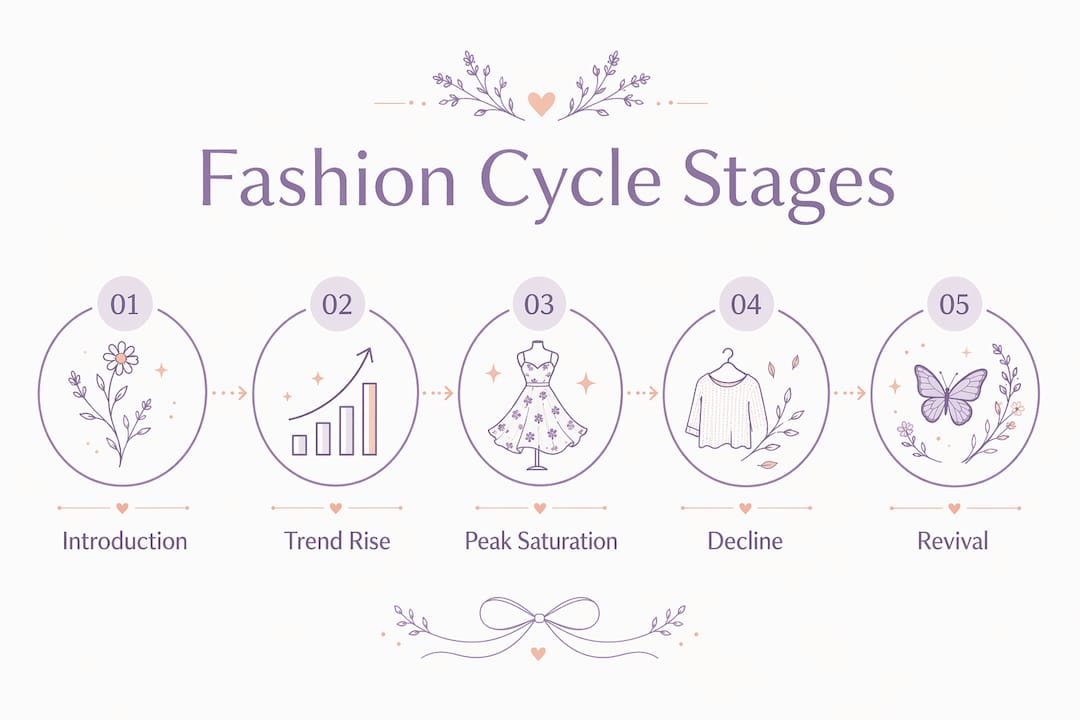
Every trend moves through five distinct stages: introduction, rise, peak, decline, and obsolescence. Together, these stages form the arc that creates the 20-year oscillation researchers have confirmed in historical fashion trends.
- Introduction. A designer or subculture debuts a new silhouette or detail. Adoption is narrow. Think of bell-bottoms appearing in late 1960s counterculture before any mainstream retailer touched them.
- Rise. Early adopters spread the look. Fashion media picks it up. The style starts appearing in mid-range stores alongside its original niche context.
- Peak. The trend reaches mass market saturation. Every retailer carries it. At this point, the style has lost its ability to signal individuality, which is exactly what triggers the next phase.
- Decline. Consumers and designers begin pulling away. The look starts to feel dated. Markdowns appear. The style retreats to clearance racks and thrift stores.
- Obsolescence. The trend disappears from mainstream view entirely. This dormancy period is critical. It lasts long enough for the style to feel fresh again to a new generation.
Skirt lengths illustrate this arc with unusual clarity. Flapper dresses in the 1920s ran short, the 1950s swung long and full, the 1960s brought the miniskirt back up, and the 1970s dropped hemlines again with hippie maxi styles. Each shift took roughly 20 years. The cycle did not happen by accident. It happened because the market mechanics of novelty and saturation operate on a human timescale.
Pro Tip: Track where a trend sits in its cycle before you buy. A style at peak saturation is about to decline. A style just entering its rise phase gives you the longest runway of relevance.
Why does the 20-year cycle reflect psychology and generational change?
The 20-year interval is not arbitrary. It maps almost exactly onto generational turnover, the time it takes for a new cohort of consumers to enter the market and rediscover styles from their parents’ youth.
Researchers at Northwestern University identified the psychological principle driving this pattern as “optimal distinctiveness.” Consumers want to be unique enough to express identity, but familiar enough to belong to a group. When a style saturates the market, it no longer delivers uniqueness. Designers then shift direction to differentiate. But they cannot shift too far without alienating buyers entirely.
“The balance designers strike is crucial: too different risks rejection, too similar leads to stagnation.” — Northwestern Engineering research on the 20-year cycle
This tension produces a predictable oscillation. Designers at institutions like the Fashion Institute of Technology study this balance formally. They learn to read market saturation signals and introduce just enough novelty to refresh a category without abandoning its familiar roots. The result is that styles cycle back with a recognizable DNA but a modern execution.
The generational factor adds another layer. A 20-year-old in 2026 did not live through Y2K fashion the first time. Low-rise jeans, butterfly clips, and velour tracksuits read as fresh and interesting to her, not tired. She adopts them as her own identity statement. This is why Y2K aesthetics returned so forcefully in the early 2020s, right on schedule.
Fashion cycles also extend beyond clothing. The same oscillatory social patterns appear in baby names and music genres, which suggests the 20-year rule reflects something deeper about how human culture processes novelty and memory.
How has the fashion cycle changed since the 1980s?
The classic 20-year cycle still operates, but its expression has become far more fragmented since the mid-1980s. Multiple hemline lengths now coexist in any given season, where pre-1980s fashion tended toward one dominant length at a time. This shift reflects a broader cultural move toward pluralism and individual expression.
| Era | Trend pattern | Dominant force |
|---|---|---|
| Pre-1980s | One dominant silhouette per cycle | Couture houses and department stores |
| 1980s–2000s | Multiple competing silhouettes | Mass market retail and MTV |
| 2000s–present | Dozens of simultaneous micro-trends | Social media and fast fashion |
Social media and globalized fast fashion have accelerated trend cycles to the point where a micro-trend can rise and fall within months. TikTok’s “cottagecore” moment in 2020 and the “quiet luxury” wave of 2023 both moved faster than any pre-digital trend. Neither replaced the underlying 20-year cycle. They layered on top of it.
Subcultures now drive mainstream fashion in ways they never did before. The role of subculture identity in shaping what reaches retail floors has grown significantly since the internet removed geographic barriers. A niche aesthetic developed in Tokyo or London can reach American shoppers within days. The 20-year cycle still underlies fashion evolution, but the surface looks noisier and faster than it did a century ago.
Pro Tip: When a micro-trend feels everywhere at once on social media, it is likely already at peak. The styles worth watching are the ones just beginning to appear on independent designers and vintage resellers.
What do repeating fashion cycles mean for your wardrobe?
Understanding the periodic fashion revival pattern gives you a real advantage when shopping. Recognizing cycles enables smarter wardrobe decisions, preventing impulse buys and helping you embrace nostalgia with intention rather than reaction.
Here is how to apply cycle knowledge practically:
- Invest in classics due for revival. If a silhouette has been dormant for 15 to 20 years, it is approaching its return window. Wide-leg trousers, for example, cycled back predictably after their 1970s and 1990s peaks.
- Distinguish cyclical trends from short fads. A cyclical trend has historical precedent and a measurable prior peak. A fad is a novelty with no prior cycle. Buying into a fad rarely pays off long-term.
- Build a core of timeless wardrobe staples. Pieces like a well-cut blazer, straight-leg denim, and a white button-down shirt have appeared in every decade’s wardrobe. They do not cycle out because they never fully cycle in.
- Use trend knowledge to time purchases. Buying a trend piece at peak means paying full price for something about to decline. Buying the same piece at the start of its rise means getting it before demand inflates prices.
- Watch fashion forecasters for early cycle signals. Professional forecasters track the same historical oscillations researchers study. Their reports often identify a revival 12 to 18 months before it reaches mass retail.
The practical upshot is straightforward. A wardrobe built on classic clothing pieces with selective trend additions will always outperform a wardrobe chasing every micro-trend. The cycle gives you the framework to know which trends are worth chasing and which will look dated within a season.
Key Takeaways
Fashion cycles repeat every 20 years through a measurable oscillation in garment features, driven by psychology, generational turnover, and the designer balance between novelty and tradition.
| Point | Details |
|---|---|
| The 20-year rule is confirmed | Analysis of 37,000 garment images from 1869 to 2026 validated cyclical peaks every two decades. |
| Psychology drives the cycle | Optimal distinctiveness theory explains why consumers abandon saturated styles and seek fresh ones. |
| Generational turnover fuels revivals | New consumers rediscover styles from their parents’ era, creating demand roughly every 20 years. |
| Modern cycles are fragmented | Since the 1980s, social media and fast fashion have created multiple simultaneous trends layered over the core cycle. |
| Cycle knowledge improves shopping | Recognizing where a trend sits in its arc helps you invest in classics and avoid peak-price impulse buys. |
The cycle is a tool, not a rulebook
I have spent years watching fashion enthusiasts treat trend cycles as either gospel or noise, and both extremes miss the point. The 20-year cycle is real and mathematically supported, but it is a framework for reading the market, not a guarantee that every style will return on schedule.
What I find most useful is treating the cycle as a confidence filter. When a style has a clear historical precedent and has been dormant for roughly two decades, I trust it more as an investment. When something feels entirely new with no prior cycle, I treat it as a fad until proven otherwise. That distinction alone has saved me from a lot of regrettable purchases.
The fragmentation of modern trends does not break the cycle. It just adds noise. The underlying oscillation between novelty and tradition still drives what designers create and what consumers want. Social media accelerates the surface churn, but the deeper rhythm holds. Once you see it, you cannot unsee it, and your relationship with shopping changes permanently.
— Patrick
Wildflowerwardrobe’s picks for cycle-aware shoppers
Knowing how trends come back is only useful if you can act on it.
Wildflowerwardrobe curates pieces that sit at the intersection of cyclical appeal and lasting style. The women’s casual wear collection includes silhouettes with strong historical precedent, the kind of pieces that look current now and will read as classics in five years. For accessories, the jewelry collection features timeless designs that complement both trend-forward and staple-based wardrobes. Whether you are building a cycle-proof wardrobe from scratch or adding one well-chosen revival piece, Wildflowerwardrobe offers options that reward thoughtful shopping over impulse buying.
FAQ
How often do fashion trends repeat?
Fashion trends repeat on a roughly 20-year cycle, confirmed by analysis of 37,000 garment images from 1869 to 2026. The cycle is driven by psychological and generational forces, not coincidence.
What causes fashion cycles to repeat?
The push-pull between wanting to stand out and wanting to fit in drives cyclical repetition. When a style saturates the market, designers shift direction, and dormant styles eventually return as fresh options for a new generation.
Has social media changed the fashion cycle?
Social media has accelerated micro-trends and increased the number of simultaneous styles, but the underlying 20-year cycle still operates. The surface moves faster; the core rhythm remains.
How can I use fashion cycle knowledge when shopping?
Buy trend pieces at the start of their rise, not at peak saturation. Invest in classics with strong historical precedent, and use seasonal wardrobe refreshes to add cycle-aware updates without overhauling your entire closet.
Why did Y2K fashion come back in the 2020s?
Y2K styles returned because generational turnover placed a new cohort of consumers in the market who had no personal memory of the original trend. That novelty, combined with the roughly 20-year dormancy period, made the revival both predictable and commercially successful.
0 comments