

Fashion forecasting is the science and art of predicting upcoming style trends by analyzing vast data sources alongside cultural signals and runway insights. Understanding how fashion forecasters predict trends matters whether you design collections, buy inventory, or simply want to shop smarter. Modern forecasting combines AI-powered image analysis, social media monitoring, and traditional runway research to identify which styles will gain traction months or years before they hit stores. The result is a discipline where data and instinct work together to shape what you wear next season.
How fashion forecasters predict trends: data sources and tools
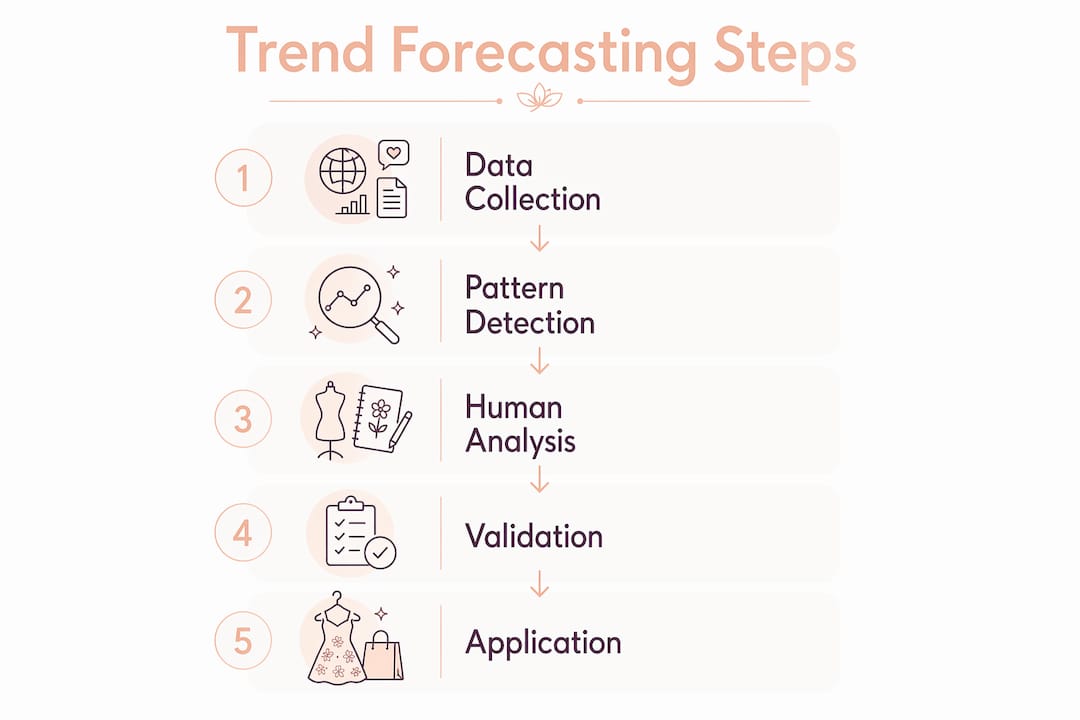
Fashion trend forecasting starts with raw inputs, and today those inputs are more diverse than ever. Forecasters draw from runway shows, trade events like Première Vision in Paris, street style photography, social media platforms, and e-commerce behavioral data. Each source captures a different layer of consumer behavior and cultural momentum.
The most powerful shift in recent years is the role of computer vision. AI algorithms process over 3 million street style photos daily, detecting granular changes like lapel widths or waistline heights to spot trends up to 18 months in advance. That level of detail would take a human team months to compile manually.

E-commerce platforms add another dimension. Behavioral data like zoom time on fabric photos outperforms add-to-cart clicks as a predictor of upcoming material trends. A shopper who lingers on a textured linen detail is signaling interest before she ever buys. These micro-interest signals typically precede mass-market adoption by about six months.
Social media listening tools like Pulsar track sentiment and conversation volume across millions of posts in real time. Real-time AI monitoring delivers a 4–12 week lead time on trends before mainstream awareness, beating slower quarterly traditional research cycles. That window is the difference between being first to market and being late.
- Runway and trade show analysis: Identifies macro aesthetic directions from designers and fabric suppliers
- Computer vision and street style: Detects micro-level detail changes at scale across global cities
- E-commerce behavioral signals: Zoom time, hover patterns, and wishlist additions reveal pre-purchase intent
- Social media listening: Tracks narrative velocity and sentiment shifts across platforms
- Predictive analytics platforms: Tools like Heuritech and Stylix Intelligence model trend longevity and peak timing
Pro Tip: Don’t rely on a single data source. Forecasters who cross-reference runway data with social sentiment and e-commerce signals produce significantly more accurate predictions than those using any one input alone.
How do predictive models analyze and validate emerging trends?
Raw data alone does not produce a forecast. Predictive models convert signals into structured predictions through several analytical stages.
- Pattern recognition against historical data. Machine learning models compare current signals to archived trend cycles. If sculptural sleeves are gaining traction now, the model checks how similar silhouette trends behaved in previous cycles to estimate trajectory.
- Velocity tracking. Velocity and sentiment trajectory often outperform raw volume as indicators. A trend growing at 40% week-over-week with moderate volume is more significant than a high-volume topic that has plateaued.
- Sentiment analysis. Models scan the emotional tone of conversations around a trend. Positive sentiment with aspirational language signals adoption potential. Ironic or critical framing often signals a trend nearing its peak.
- Segment mapping. Segmentation mapping links emerging trends to specific consumer profiles, helping brands tailor products and marketing to target psychographics. Sculptural sleeves, for example, score high with Trend Maximalists and low with Functional Minimalists.
- Multistage reporting. Forecasting bureaus like WGSN release multi-stage reports from 6 to 24 months ahead, evolving from broad cultural themes down to specific garment and color directives.
| Method | Primary strength | Limitation |
|---|---|---|
| Computer vision | Detects micro-detail changes at scale | Misses cultural context behind the change |
| Social listening | Captures real-time sentiment and velocity | Skews toward digitally active demographics |
| E-commerce behavioral data | Reveals pre-purchase intent early | Limited to existing product categories |
| Historical pattern matching | Estimates trend lifecycle stage | Past cycles don’t always repeat exactly |
Brands using predictive analytics achieve 4–12 week lead times over traditional methods, with up to 42% greater trend adoption accuracy projected by end of 2026. That accuracy gap translates directly into fewer markdowns and better sell-through rates.
What role do human expertise and cultural context play?
AI identifies patterns. Humans explain why those patterns matter. That distinction is the foundation of effective fashion trend analysis.
A computer vision model can flag that sheer layering is accelerating across 3 million images. It cannot tell you that the trend connects to a broader cultural conversation about vulnerability, transparency, and post-pandemic self-expression. Human editorial instinct adds essential context explaining why trends resonate, which is what transforms a data point into a brand strategy.
Cultural forecasters monitor what sociologists call “weak signals,” which are early, fragmented indicators that something is shifting in values or behavior. A spike in cottagecore aesthetics on Pinterest in 2020 was a weak signal for the broader slow-living movement that followed. No algorithm flagged it as significant at the time. An experienced forecaster did.
- Trend narrative building: Forecasters weave fragmented signals into coherent stories that brands can act on
- Weak signal detection: Human analysts spot cultural undercurrents before they register statistically
- Brand alignment editing: Experts filter AI outputs through a specific brand’s DNA and customer values
- Cross-cultural interpretation: Global trends require local context that models trained on Western data often miss
Creative trend narratives post-rationalize early and fragmented cultural signals to build coherent trend stories. This is not guesswork. It is a structured editorial process that gives brands a narrative framework to align collections, campaigns, and messaging.
Pro Tip: When studying a trend report, read the narrative section first, not the color palettes. The story behind a trend tells you whether it has cultural staying power or is a short-cycle fad.
How do forecasters apply trend predictions for brands and designers?
Forecasting only creates value when it connects to real business decisions. The practical application of fashion prediction techniques spans product development, marketing, and inventory planning.
Forecasting timelines are structured in layers. Long-range forecasts (18–24 months out) focus on macro cultural shifts and material innovation. Mid-range forecasts (9–12 months) address silhouette, color, and print direction. Short-range forecasts (3–6 months) guide production volumes and retail timing. Each layer informs a different business function.
| Forecast horizon | Primary use | Key decision |
|---|---|---|
| 18–24 months | Fabric sourcing and design direction | Which materials to develop |
| 9–12 months | Collection planning and color stories | Which silhouettes to produce |
| 3–6 months | Production volume and retail timing | How much to make and when to launch |
| 0–3 months | Marketing and merchandising | How to position and promote |
Understanding trend velocity guides production timing and scale. A trend with high velocity and early-stage adoption signals a window to produce at scale before saturation. A trend showing plateau signals are a cue to reduce production and clear inventory before markdowns become necessary.
Segment insights sharpen targeting. A brand serving professional women in their 30s does not need to act on every trend a 19-year-old TikTok creator is wearing. Forecasters map trend adoption curves by psychographic segment, so brands invest only in the trends their specific customer will actually buy. You can apply this same logic to your own wardrobe by using a trend-proof wardrobe checklist to filter trends by your personal style profile.
Avoiding overproduction is one of forecasting’s most undervalued outputs. Peak and plateau detection tells brands when a trend has reached maximum saturation. Acting on that signal prevents the excess inventory that drives both financial loss and environmental waste.
Key takeaways
Fashion forecasting combines AI-powered data analysis with human editorial judgment to deliver accurate, timely, and brand-relevant trend predictions.
| Point | Details |
|---|---|
| AI processes signals at scale | Computer vision and social listening tools detect micro-trends months before mainstream adoption. |
| Velocity beats volume | A fast-growing trend with moderate volume predicts lasting adoption better than a high-volume fad. |
| Human context is non-negotiable | Forecasters build narratives that explain why trends resonate, which data alone cannot do. |
| Forecasts operate in layers | Timelines from 3 to 24 months serve different business functions, from sourcing to merchandising. |
| Segmentation sharpens decisions | Matching trends to consumer psychographics prevents wasted production and misaligned marketing. |
Why I think most people misread what forecasters actually do
The common assumption is that fashion forecasters are tastemakers who decide what becomes popular. That framing is backwards. The best forecasters I have studied are listeners, not dictators. They read culture, decode behavior, and translate signals into language brands can use.
What strikes me most about modern forecasting is the model decay problem. AI models require continuous retraining to stay relevant as consumer trends shift rapidly. A model trained on 2023 data will misread 2026 signals. This is why effective brands monitor trends continuously rather than relying on isolated annual forecasts. The market moves too fast for a once-a-year report to stay accurate.
The other thing most articles get wrong is the role of uncertainty. Forecasting embraces uncertainty through creative storytelling rather than pretending to eliminate it. A great trend report does not say “this will happen.” It says “here is the cultural logic that makes this plausible, and here is how to position your brand if it does.” That distinction separates useful forecasting from noise.
For anyone who loves fashion and wants to understand it more deeply, I recommend studying both data literacy and cultural theory. Read the WGSN trend reports alongside books on sociology and consumer psychology. The forecasters who combine both skill sets are the ones whose predictions hold up.
— Patrick
Shop trends before they peak with Wildflowerwardrobe
Knowing how trends move gives you a real advantage when you shop. You stop chasing what everyone already owns and start building a wardrobe with pieces that have staying power.

Wildflowerwardrobe curates women’s casual wear with exactly this in mind, selecting pieces that align with emerging trend directions rather than last season’s clearance. From statement accessories to everyday essentials, the collection reflects the kind of considered curation that forecasters apply to brand buying. If you want to shop with the same informed perspective that industry professionals use, start with the pieces that are already tracking upward. Your wardrobe will thank you for it.
FAQ
How far in advance do fashion forecasters predict trends?
Professional forecasting bureaus like WGSN release reports 6–24 months ahead, with some extended forecasts covering up to five seasons. The timeline depends on the business function, with fabric sourcing requiring the longest lead time and marketing decisions using the shortest.
What is the most accurate method for predicting fashion trends?
Combining AI-powered computer vision with social listening and human editorial analysis produces the highest accuracy. Brands using predictive analytics achieve up to 42% greater trend adoption accuracy compared to traditional methods alone.
How do forecasters know if a trend will last or fade quickly?
Velocity and sentiment trajectory are the key indicators. A trend growing steadily with positive, aspirational sentiment signals lasting adoption. High volume with flat or ironic sentiment typically signals a short-cycle fad near its peak.
What tools do professional fashion forecasters use?
Forecasters use platforms like Heuritech for computer vision analysis, Pulsar for social listening, and WGSN for multi-stage trend reporting. E-commerce behavioral data from retail platforms adds micro-interest signals that precede mass-market adoption.
Can everyday shoppers use fashion forecasting insights?
Yes. Understanding trend velocity and lifecycle stages helps you buy pieces at the right moment, before saturation drives prices up and quality down. A seasonal outfit planning approach applies the same timing logic that brands use to build a wardrobe that stays relevant longer.
0 comments