

Wardrobe essentials are the core clothing items you wear repeatedly across seasons, and they are the most reliable way to cut your annual clothing spend. The concept behind why wardrobe essentials save money comes down to one financial metric: cost-per-wear (CPW). A $200 quality blazer worn 100 times costs $2 per wear. A $30 trend top worn twice costs $15 per wear. The math is unambiguous. Brands like Patagonia and research platforms like Outflik confirm that durable, versatile pieces consistently outperform cheap, disposable fashion in real financial terms.
Why wardrobe essentials save money through cost-per-wear
Cost-per-wear is the single most useful number in personal finance for clothing. The formula is simple: divide what you paid by how many times you wear the item. That number tells you the true price of every outfit you put on.

Most people shop by price tag. CPW flips that logic entirely. CPW shifts mindset from chasing the lowest sticker price to valuing repeated use, which is where actual savings happen. A $40 fast fashion t-shirt worn 4 times costs $10 per wear. A $90 cotton essential worn 200 times costs $0.45 per wear. The cheaper item costs 22 times more per use.
Here is how CPW plays out across three common wardrobe scenarios:
- Fast fashion blouse: $25 purchase price, worn twice before fading or falling apart. CPW = $12.50.
- Quality wardrobe essential dress: $120 purchase price, worn 80 times over three years. CPW = $1.50.
- Classic denim jeans: $80 purchase price, worn 200 times over five years. CPW = $0.40.
The CPW formula also accounts for maintenance and resale. If you spend $10 on alterations for a $100 dress and later sell it for $40, your net cost is $70. Worn 60 times, that is $1.17 per wear. Resale and repair both reduce your effective spend, which is why quality items with strong resale markets deliver compounding savings over time.
Pro Tip: Track your CPW for 30 days using a simple notes app. Log every item you wear and divide its original price by total wears. Most women discover 20% of their wardrobe accounts for 80% of their actual outfits.
One critical caveat: CPW only delivers savings if you actually wear the item. Buying for aspirational occasions rather than your real life is the fastest way to waste money, even on quality pieces. Buy for the life you live, not the life you imagine.
How durability and quality lower your long-term clothing costs
Quality and durability are not luxury concepts. They are financial strategies. A garment that lasts five or more years costs far less over time than one replaced every season, regardless of the original price difference.
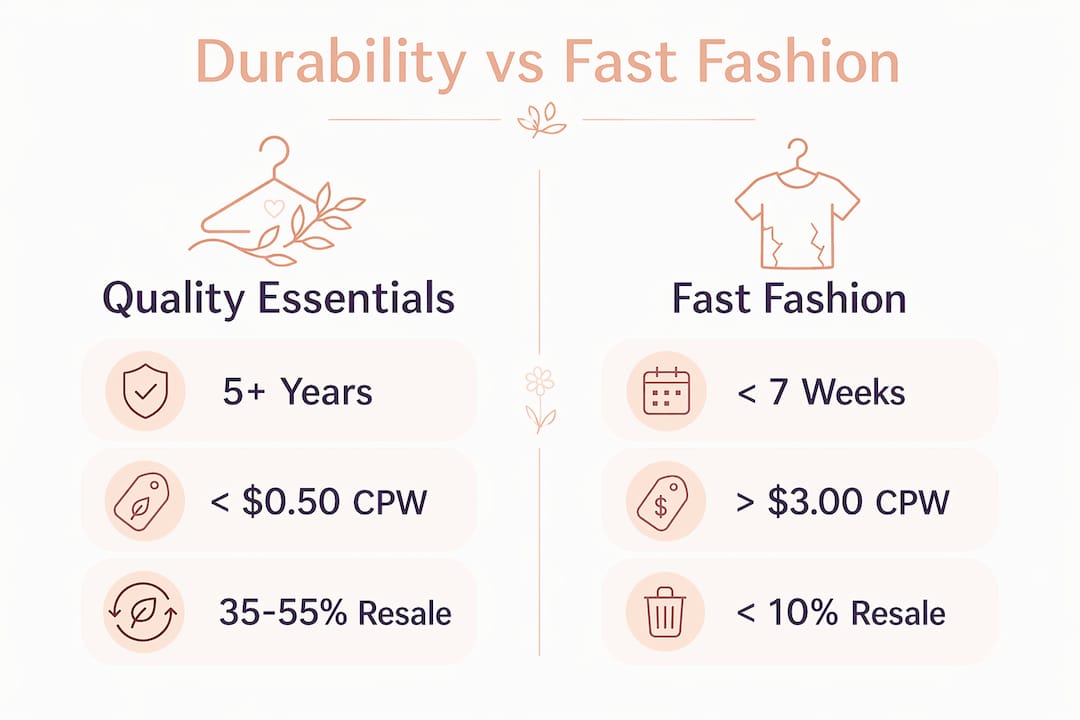
The numbers from Sustainability Atlas make this concrete. Sustainable brands achieve CPW under $0.50 compared to fast fashion items that average over $3.00 per wear, driven by lifespan differences of more than five years versus under one year. That gap compounds across an entire wardrobe. A woman replacing five fast fashion basics annually at $30 each spends $150 per year on those items alone. Buying quality versions once for $90 each and wearing them for five years costs $18 per year per item.
Resale value adds another financial layer. Premium brands retain 35 to 55% of their resale value after two years, while fast fashion retains only 8 to 15%. That means a $150 quality coat can be sold for $60 to $80 after years of use. A $40 fast fashion coat might fetch $4 at resale, if it sells at all.
| Comparison point | Quality essentials | Fast fashion items |
|---|---|---|
| Average lifespan | 5+ years | Under 1 year |
| Cost-per-wear | Under $0.50 | Over $3.00 |
| Two-year resale value | 35 to 55% | 8 to 15% |
| Repair cost to extend life | $8 to $25 | Rarely worth repairing |
Maintenance and repair extend this advantage further. Patagonia’s Worn Wear program averages $15 per repair and adds 2.2 years to garment lifespan. Even outside branded programs, basic repairs like replacing a button or re-hemming a pair of trousers cost $8 to $25 and can extend a garment’s useful life by years.
Pro Tip: When buying a new essential, check whether the brand offers repair services or has a strong secondhand resale market on platforms like ThredUp or Poshmark. That information directly affects the item’s true long-term cost.
How wardrobe essentials reduce clutter and impulse spending
The financial damage from a disorganized wardrobe is not just about what you paid. It is about what you keep buying because you cannot see what you already own. Wardrobe essentials solve this by creating a coordinated system where every item works with everything else.
Eliminating orphaned pieces and improving wardrobe coordination directly reduces impulse purchases and maximizes closet value. When you own 10 items that all work together, you stop buying the “missing piece” that never quite fits the rest of your closet.
The data from capsule wardrobe research is striking:
- A study with 24 participants found that adopting a capsule wardrobe approach led to 78% fewer impulse buys and 80% fewer unworn items.
- Participants saved an average of $1,200 annually by reducing shopping frequency and eliminating low-use purchases.
- Fewer items also meant faster morning routines and measurably lower decision fatigue.
The psychology here matters. When your closet contains only items you actually wear, you stop browsing out of frustration. You stop buying duplicates of things you forgot you owned. You stop replacing items that were never worn out, only forgotten. Learning how to build a capsule wardrobe is one of the most practical steps toward cutting your annual clothing spend.
Fast fashion accelerates this problem. Items last only about 7 weeks on average in active rotation before being pushed to the back of the closet, costing $150 to $200 per clothing category annually even at low individual prices. Wardrobe essentials break this cycle by staying relevant, wearable, and visible across seasons.
Practical ways to build a budget wardrobe with essentials
Building a cost-effective wardrobe does not require a complete overhaul or a large upfront investment. It requires a clear system and a few deliberate decisions.
-
Run a closet audit first. Pull everything out and track what you actually wear. Wardrobe visibility tools and audits prevent duplicate purchases and reveal which items have the worst CPW. Apps like Stylebook or Whering let you log outfits and calculate CPW automatically.
-
Apply the splurge, spend, and save framework. Invest more in denim, knitwear, and shoes since these are high-wear, high-CPW categories. Spend moderately on everyday tops and layering pieces. Save on occasion wear and trend items you will wear only a few times.
-
Prioritize neutral colors and classic fits. Neutral colors like black, white, navy, and camel maximize mix-and-match potential, which means more outfit combinations from fewer items. Classic fits do not go out of style, so you are not replacing them every two years.
-
Repair before replacing. A $12 hem repair on a pair of well-fitting trousers beats spending $60 on a new pair. Build a relationship with a local tailor or learn basic repairs yourself. The cost savings over five years are significant.
-
Shop secondhand for quality essentials. The global secondhand apparel market reached $227 billion in 2025 and is growing at 12% annually. Platforms like ThredUp, Poshmark, and The RealReal offer quality basics at 50 to 70% below retail, with strong CPW profiles from day one. Secondhand clothes can be 33% cheaper than fast fashion when total cost over time is factored in.
-
Treat your wardrobe as a system. Wardrobe staples work best as part of a repeatable structure that simplifies daily choices and reduces how often you need to shop. Every new purchase should answer one question: does this work with at least three things I already own?
Key takeaways
Wardrobe essentials save money by lowering cost-per-wear through durability, versatility, and reduced impulse spending across every category you own.
| Point | Details |
|---|---|
| Cost-per-wear is the core metric | Divide item price by number of wears to find the true cost of any garment. |
| Quality beats cheap over time | Sustainable essentials average under $0.50 CPW versus over $3.00 for fast fashion. |
| Capsule wardrobes cut annual spend | Research shows participants saved $1,200 per year with fewer, more coordinated items. |
| Repair and resale reduce net cost | Quality brands retain 35 to 55% resale value; basic repairs add years to garment life. |
| Secondhand shopping amplifies savings | The resale market offers quality essentials at 50 to 70% below retail prices. |
What I have learned from building a wardrobe around essentials
I spent years buying cheap pieces that looked good in the store and fell apart within months. My closet was full and I still felt like I had nothing to wear. That is the paradox of a wardrobe built on impulse rather than intention.
Switching to a system built around classic wardrobe staples changed two things immediately. My morning routine got faster because every item worked with everything else. And I stopped shopping out of frustration, which is where most of the real money was leaking.
The challenge most women face is the upfront cost. Spending $90 on a single top feels harder than spending $20 three times, even though the math clearly favors the former. The mindset shift takes time. I found it helped to track CPW for just one month before making any new purchases. Seeing the numbers made the decision obvious.
The other thing nobody tells you: a smaller, well-chosen wardrobe builds confidence in a way a stuffed closet never does. Coordinated core items enable faster, more satisfying outfit choices and reduce the low-level stress of getting dressed. That is a benefit no price tag captures, but it is real.
— Patrick
Build your budget wardrobe with Wildflowerwardrobe
Knowing the theory is one thing. Having the right pieces to start with is another.

Wildflowerwardrobe curates a collection of versatile, budget-smart essentials designed for exactly this kind of intentional wardrobe building. The women’s casual wear collection focuses on classic fits, neutral-friendly colors, and pieces built to be worn repeatedly across seasons. These are not trend items. They are the foundation pieces that lower your CPW from day one. If you are ready to stop replacing and start investing in what you wear, Wildflowerwardrobe is a practical place to begin. Browse the collection and apply the splurge, spend, and save framework to every item you consider.
FAQ
What are wardrobe essentials exactly?
Wardrobe essentials, also called wardrobe staples, are versatile clothing items worn frequently across multiple seasons and outfit combinations. Classic examples include well-fitting denim, a white button-down shirt, a neutral blazer, and a quality t-shirt in a neutral color.
How much money can wardrobe essentials actually save?
Research from a capsule wardrobe study found that participants saved an average of $1,200 per year by reducing impulse purchases and wearing fewer, more coordinated items more often.
Is it worth spending more on quality essentials?
Yes. Quality essentials achieve a cost-per-wear under $0.50 compared to over $3.00 for fast fashion items, and they retain 35 to 55% of their resale value after two years versus 8 to 15% for cheaper alternatives.
How do I start building a budget wardrobe with essentials?
Start with a closet audit to identify what you already wear and what you do not. Then apply the splurge, spend, and save framework: invest in high-wear categories like denim and shoes, and save on trend or occasion pieces.
Does secondhand shopping fit into a wardrobe essentials strategy?
Secondhand shopping is one of the most cost-effective ways to build a quality wardrobe. The global resale market reached $227 billion in 2025, and quality essentials bought secondhand can cost 50 to 70% less than retail while still delivering strong cost-per-wear performance.
Recommended
- How to Update Your Wardrobe Without Overspending – Wildflower Wardrobe
- Everyday wardrobe essentials women need for stylish versatility – Wildflower Wardrobe
- How to invest in classic wardrobe staples that last – Wildflower Wardrobe
- Build a trend-proof wardrobe with the right checklist – Wildflower Wardrobe
0 comments