

Accessorizing a simple outfit is the art of choosing one striking focal piece and pairing it with two or three subtle supporting accessories to create a polished, complete look. The 1-statement-rule is the industry standard for this approach: pick one bold piece, whether oversized earrings, a structured bag, or a standout belt, and let everything else play a quieter role. This principle keeps your look intentional rather than cluttered. Wildflowerwardrobe’s curated collections are built around exactly this idea, offering timeless pieces that work hard across multiple outfits and occasions.
What are the essential accessory categories for simple outfits?
Every accessory falls into one of two roles: focal or supporting. Knowing which role each category plays gives you a clear framework for building any look.
Jewelry is the most flexible category. Statement earrings, layered necklaces, and stacked bracelets each bring a different energy. Oversized earrings work as a focal piece on their own. A simple chain necklace, by contrast, acts as a finishing touch rather than the main event.

Bags do more styling work than most women realize. Swapping your bag can shift a jeans-and-tee look from casual to polished in seconds. A colorful structured clutch reads as a focal piece. A neutral tote reads as support.
Belts are underused and underrated. A wide belt with a standout buckle cinches an oversized dress and creates instant structure. A slim leather belt threads through jeans to add a quiet finishing detail without competing for attention.
Scarves and headbands add texture and color in a way that jewelry cannot. Tied around your neck, looped through a bag handle, or worn as a headband, a silk scarf brings softness and dimension to even the plainest outfit.
Shoes and sunglasses function as accessories even when you think of them as practical items. A bold shoe color or an architectural frame can carry an entire look without a single piece of jewelry.
- Statement earrings: focal piece, pair with minimal necklace
- Structured bags: focal or supporting depending on color and size
- Belts: silhouette-shaping, focal or finishing detail
- Scarves: texture and color, body or bag styling
- Shoes: color or shape can anchor the whole look
- Sunglasses: frame the face and set the mood
Pro Tip: Timeless staples like hoop earrings, simple leather belts, and neutral structured bags deliver the most styling versatility. Build around these before adding trend-driven pieces.
How do you coordinate colors, metals, and textures?
Color, metal tone, and texture are the three variables that determine whether your accessories look intentional or accidental. Controlling all three at once is simpler than it sounds.
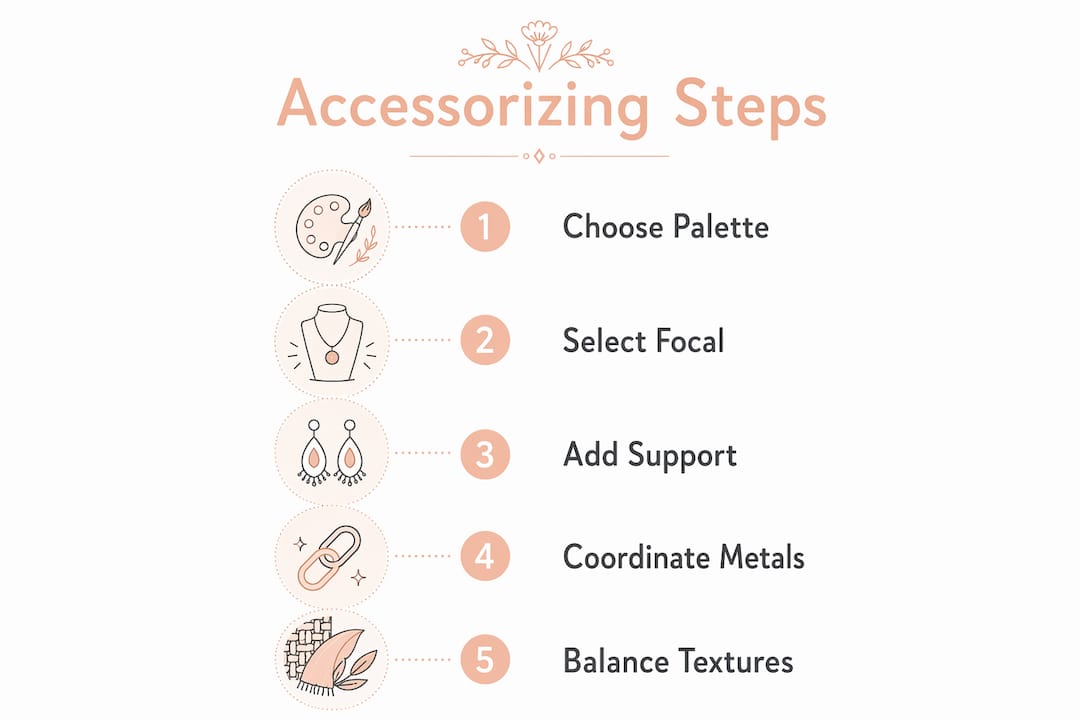
Color coordination
Limit your accessory palette to two or three colors maximum. One of those colors should appear in your outfit. The others can contrast or complement. A white tee and blue jeans pair naturally with tan leather, warm gold, or a pop of terracotta. Adding a fourth color breaks the visual logic and reads as noise.
Bright accessories work best against neutral outfits. A cobalt blue bag against a beige linen set is a clear, confident choice. That same cobalt bag against a printed dress creates competition rather than contrast.
Metal harmony
Gold and silver mix well when you commit to a dominant tone. Choose one metal for your largest or most visible piece, then allow the other to appear in smaller details. Mixing metals randomly, without a dominant tone, creates visual confusion. Keeping one metal family as the lead, such as gold for earrings and belt buckle, with silver only in a thin ring, reads as intentional.
Texture as a layering tool
Texture adds depth to a look without adding color or weight. Two to three material types create balance without clutter. Leather, suede, metal, and woven fabrics each catch light differently. A woven straw bag, leather sandals, and gold hoop earrings together create richness that a single-material look cannot achieve.
Pro Tip: Define the outfit’s tone before you accessorize. A relaxed linen set calls for natural textures and warm metals. A sleek black dress calls for polished metals and structured leather. Matching the mood prevents mismatched signals.
| Outfit base | Recommended metals | Recommended textures |
|---|---|---|
| White tee and jeans | Gold or silver | Leather, woven, metal |
| Neutral linen set | Warm gold | Suede, straw, natural fiber |
| Black dress | Silver or polished gold | Structured leather, metal |
| Floral midi dress | Gold | Woven, soft fabric, wood |
Step-by-step: how to accessorize common simple outfit bases
The method works the same regardless of what you are wearing. Start with one focal piece, then build around it with two or three supporting choices.
Jeans and a tee
- Choose your focal piece. Bold earrings, a colorful bag, or a statement belt each work here. Pick one. If you choose oversized earrings, the bag and belt should be quiet.
- Add one supporting accessory. A thin layered necklace or a simple leather belt adds polish without competing.
- Finish with shoes. A pointed-toe flat or a clean white sneaker completes the look. If your focal piece is already bold, keep shoes neutral.
- Edit before you leave. Look in a full-length mirror and remove one item if anything feels like too much.
A basic dress
Belts shape a dress’s silhouette quickly and are the single most effective tool for a simple dress. Cinch a midi dress at the waist with a wide belt and you have created structure without changing the garment. Add small hoop earrings and a neutral bag. That is three accessories total, and the look is complete.
For an evening occasion, swap the belt for a statement necklace. Keep earrings small when the necklace is bold. Oversized earrings pair best with a minimal necklace, and a bright handbag works best with neutral jewelry.
Neutral separates
Neutral separates, such as cream trousers and a beige blouse, give you the most freedom because the outfit itself does not compete. This is where a scarf earns its place. Tie a printed silk scarf around your neck or loop it through the handle of a structured bag. Add one metal accessory, a gold cuff or a chain necklace, and the look has texture, color, and polish.
Pro Tip: Layered necklaces add dimension without overpowering simple tops. Combine a thin chain with a medium pendant chain, and match necklace length to your neckline. A V-neck calls for a longer pendant; a crew neck suits a shorter choker-length chain.
You can also learn how to style caps and hats as a focal accessory for casual looks, particularly with jeans and tee combinations where a structured cap adds personality without jewelry.
Consider your body frame when choosing accessory scale. Petite frames suit refined, smaller accessories, while oversized pieces complement relaxed silhouettes to maintain visual balance.
What accessorizing mistakes should you avoid?
Over-accessorizing is the most common mistake, and it is also the easiest to fix. Simplifying your accessories almost always produces a more polished result than adding more.
- Wearing too many focal pieces at once. Bold earrings, a statement necklace, a bright bag, and a wide belt together create visual overload. Choose one.
- Mixing clashing metals randomly. Wearing gold earrings, a silver necklace, and a rose gold watch without a dominant tone reads as unplanned.
- Ignoring proportion. A petite frame overwhelmed by a large structured tote and oversized earrings loses balance. Scale your accessories to your frame and your outfit’s silhouette.
- Choosing accessories that clash with the occasion. Chandelier earrings with a gym-casual outfit, or a tiny delicate chain with a formal evening gown, both send mismatched signals.
- Neglecting comfort. An accessory you keep adjusting or removing mid-day is not working for you. Comfort and wearability are part of the styling equation.
“Accessories help create mood, express identity, add versatility, and complete an outfit. Balancing color, texture, and proportion are the keys to making them work. The goal is intention, not decoration.”
The simplest edit: put everything on, then remove one piece. If the look improves, you found the problem. If it does not, put the piece back. This one habit will sharpen your eye faster than any style rule.
Key Takeaways
The most effective way to accessorize a simple outfit is to apply the 1-statement-rule: choose one bold focal piece, support it with two or three complementary accessories, and edit ruthlessly before you leave the house.
| Point | Details |
|---|---|
| Apply the 1-statement-rule | Choose one bold focal piece and limit supporting accessories to two or three. |
| Control color and metal tone | Stick to two or three colors and pick one dominant metal family per look. |
| Use texture intentionally | Combine two to three materials like leather, suede, and metal for depth without clutter. |
| Match scale to your frame | Petite frames suit smaller accessories; relaxed silhouettes carry oversized pieces better. |
| Edit before you go | Remove one accessory if the look feels like too much. Simplicity reads as polish. |
Why less is genuinely more when it comes to accessories
I spent years thinking more accessories meant more style. A statement necklace, bold earrings, two bracelets, and a printed scarf, all at once. The result was never the polished look I was aiming for. It was noise.
The shift happened when I started treating accessories the way a good editor treats words: cut until only the necessary ones remain. One pair of gold hoop earrings with a clean white shirt and tailored trousers said more than the full collection ever did. That restraint is not a limitation. It is a skill.
What I have found is that women often underestimate what they already own. A classic wardrobe staple like a simple leather belt or a structured bag can be styled ten different ways across ten different outfits. The variety comes from how you use the piece, not from buying more pieces.
Accessorizing becomes intuitive with practice. Start with the 1-statement-rule for two weeks. You will stop second-guessing and start seeing your wardrobe differently. Confidence in your choices is the final accessory, and it costs nothing.
— Patrick
Wildflowerwardrobe’s picks for elevating simple outfits
Wildflowerwardrobe carries the kind of accessories that make the 1-statement-rule easy to apply. The jewelry collection includes hoop earrings, layered chain necklaces, and earring-and-necklace sets designed to work as focal pieces or quiet finishing touches depending on how you style them.
For bags, the Fame Multi Belt Strap Accent Shoulder Bag brings texture and structure in one piece, making it a natural focal accessory for neutral or monochrome outfits. The casual wear collection pairs well with these accessories for a complete, cohesive look. Every piece is chosen to mix easily with what you already own, so you can build a versatile accessory wardrobe without starting from scratch.
FAQ
What is the 1-statement-rule in accessorizing?
The 1-statement-rule means choosing one bold focal accessory, such as oversized earrings, a structured bag, or a standout belt, and supporting it with two or three quieter pieces to prevent visual competition.
How many accessories should you wear at once?
Three to four accessories is the practical limit for most looks. One focal piece plus two or three supporting accessories creates a complete, polished result without clutter.
Can you mix gold and silver accessories?
Yes, but choose one dominant metal tone for your largest or most visible piece. Allow the secondary metal to appear only in smaller details to keep the combination looking intentional.
What is the best accessory for a basic dress?
A belt is the most effective single accessory for a basic dress. It shapes the silhouette instantly and works as either a focal piece or a quiet structural detail depending on its width and buckle.
How do you accessorize for different occasions with the same outfit?
Swap your bag and shoes to shift the tone of any basic outfit. A neutral dress with a structured clutch and heels reads as evening-ready. The same dress with a tote and flat sandals reads as casual and relaxed.
0 comments