

Fashion seasons are defined as the scheduled cycles in the apparel industry that dictate when collections are designed, presented, and sold. The traditional system organizes the year around two primary periods: Spring/Summer and Autumn/Winter. Luxury and mid-market brands have expanded this to four or more cycles by adding Resort and Pre-Fall collections. Understanding how fashion seasons work gives you a real edge, whether you are planning a personal wardrobe, forecasting trends, or building your first collection. The Big Four fashion weeks in New York, London, Milan, and Paris anchor this entire calendar.
How fashion seasons work: the core calendar explained
The global fashion industry runs on two primary cycles, with runway shows held 6–7 months before collections reach retail. That gap is not accidental. It gives manufacturers, buyers, and retailers time to produce, ship, and merchandise the pieces you eventually see on the floor.
Spring/Summer collections are presented on the runway in september and october. Those pieces arrive in stores between february and july. Autumn/Winter collections follow the opposite rhythm, with runway shows in february and march and retail availability from august through january. This is the backbone of the fashion season timeline every professional works around.
Luxury brands have pushed further. Resort and Pre-Fall collections now fill the gaps between the two main seasons. Resort collections are shown in november and december, landing in stores in may and june. Pre-Fall collections are presented in may and june, with retail delivery in july and august. The result is a near-continuous product cycle for high-end consumers.
The table below maps the full four-season model so you can see the calendar at a glance.
| Season | Runway presentation | Retail availability |
|---|---|---|
| Spring/Summer (SS) | September–October | February–July |
| Autumn/Winter (AW) | February–March | August–January |
| Resort | November–December | May–June |
| Pre-Fall | May–June | July–August |
The Big Four fashion weeks in New York, London, Milan, and Paris serve as the official markers for SS and AW presentations. They are the moments when the industry sets its direction for the coming season.
How does the fashion calendar affect design, production, and retail?
The fashion calendar creates a chain of deadlines that starts long before any garment hits a store. Retailers must commit to inventory months before customers decide what to buy. Missing a single milestone can cascade into late deliveries, lost shelf space, and forced markdowns.
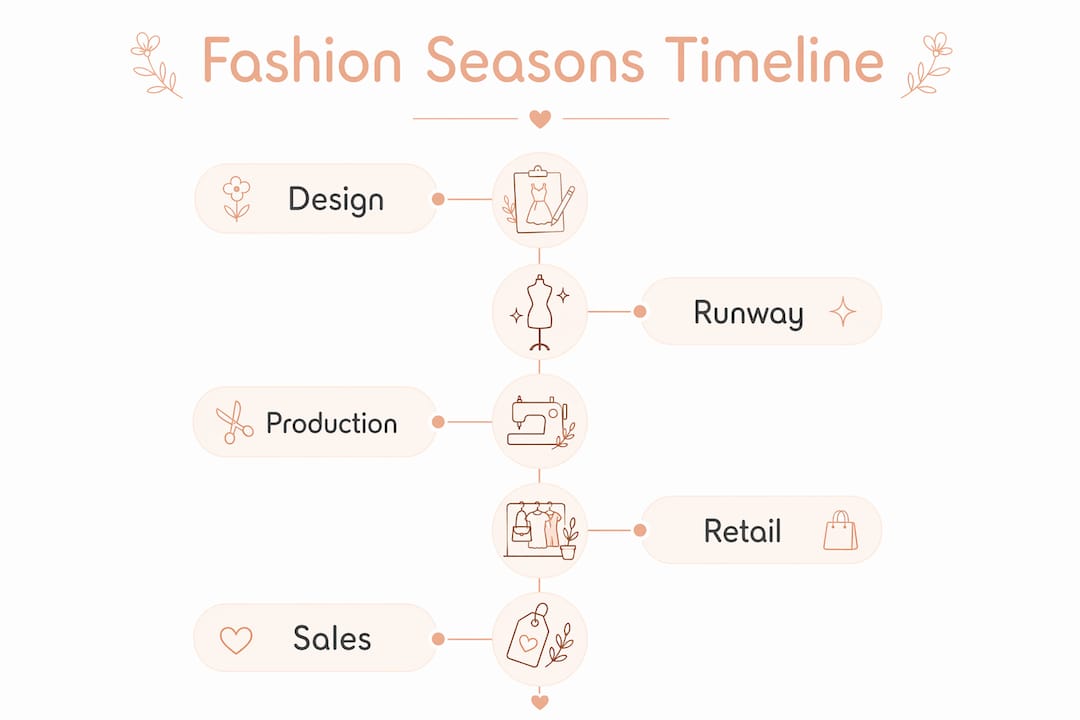
Most professionals manage three seasons at once. They are selling the current season, producing the next, and designing the one after that. Backward planning from fixed retail milestones keeps all three tracks from colliding.
The sequential stages from concept to customer look like this:
- Design brief and concept development — creative direction is set, mood boards and color palettes are finalized.
- Fabric sourcing and material selection — suppliers are confirmed and swatches are approved.
- Sampling and fit review — prototypes are made, adjusted, and signed off.
- Production order placement — confirmed designs go to factory with quantity commitments.
- Quality control and inspection — finished goods are checked before shipment.
- Logistics and shipping — product moves from factory to distribution center.
- Retail floor delivery and merchandising — product arrives in stores and is set for sale.
The full-price selling window for seasonal fashion is typically only 4–6 weeks before markdowns begin. That short window means every delay in the production chain directly cuts into margin. Retailers then use early sales data within the first 10 days after launch to predict overall performance and adjust inventory before discounting begins.
Pro Tip: Use a PLM (Product Lifecycle Management) tool or even a shared planning calendar to visualize overlapping seasonal workflows. Managing multiple seasons simultaneously without a visual timeline is the fastest way to create resource bottlenecks and missed ship dates.
What are the modern variations in fashion seasons?
The traditional two-season model no longer describes the full industry. Fast fashion brands produce far more collections per year than traditional houses. Zara produces 24 collections annually. H&M releases 12–16 per year. Ultra-fast fashion platforms introduce thousands of new items daily. That pace has no equivalent in the traditional seasonal calendar.
The see-now-buy-now model emerged as a direct challenge to the 6-month runway-to-retail gap. Under this approach, collections go on sale the moment they are shown on the runway. The appeal is obvious for consumers. The supply chain challenge is enormous, requiring finished production before the show rather than after it.
Capsule collections and transitional drops have also become standard tools. Brands release small, focused collections outside the main fashion weeks to maintain consumer attention between major seasons. These drops often respond to cultural moments, collaborations, or viral trends rather than the traditional seasonal calendar.
Regional market variations add another layer. India’s festival season calendar, for example, drives a distinct retail cycle around Diwali and wedding season that does not align neatly with the Western SS/AW structure. Brands serving those markets adapt their timelines accordingly.
The tradeoffs of non-traditional season models are real:
- Pros: faster response to trends, higher consumer engagement, more frequent revenue opportunities, reduced risk of missing a cultural moment.
- Cons: higher production costs, greater environmental impact, compressed design timelines, increased pressure on supply chain partners, and reduced time for quality control.
Understanding these variations helps aspiring designers choose which model fits their brand’s capacity and values before committing to a production schedule.
How can you use fashion seasons for trend forecasting and style planning?
Fashion seasons are planned up to two years in advance through forecasting, which means the trends you see on the runway today were set in motion long before the show. For aspiring designers, this is the most important structural insight in the entire system. Reactive design is always late.
Runway shows are early previews, not immediate shopping opportunities. Consumers who treat them as future signals rather than current catalogs make smarter wardrobe decisions. They know what is coming and can plan purchases accordingly rather than impulse-buying pieces that duplicate what they already own.
For personal style planning, the seasonal calendar offers a practical framework:
- Watch SS runway shows in september and october to identify the color stories and silhouettes arriving in stores by february.
- Use AW runway coverage in february and march to plan fall wardrobe investments before the best pieces sell out.
- Build a seasonal clothing checklist to track what you need before each retail window opens.
- Engage with Resort and Pre-Fall drops to fill wardrobe gaps between the two main seasons.
- Follow official fashion week calendars from the Council of Fashion Designers of America (CFDA) and the British Fashion Council to stay current on presentation dates.
Consumers who wait for end-of-season sales risk losing access to full sizes and styles. The best pieces move early in the full-price window. Knowing the retail calendar lets you shop with intention rather than luck.
Pro Tip: Bookmark the official CFDA fashion calendar and check how fashion forecasters predict trends before each major runway season. Thirty minutes of pre-season research saves hours of reactive shopping and keeps your wardrobe coherent.
For aspiring designers, the practical move is to map your own design brief dates backward from your target retail delivery. If you want product in stores for february, your design brief needs to be complete by the previous spring. The calendar does not flex. Your planning has to.
Key Takeaways
The fashion season calendar is a fixed operational structure, and understanding it separates reactive shoppers and designers from those who plan with precision and confidence.
| Point | Details |
|---|---|
| Two core seasons drive the industry | Spring/Summer and Autumn/Winter each follow a 6–7 month runway-to-retail timeline. |
| Luxury brands run four or more cycles | Resort and Pre-Fall collections fill the gaps, keeping consumer engagement year-round. |
| Full-price windows are short | The selling window at full price lasts only 4–6 weeks before markdowns begin. |
| Runway shows are future signals | Collections shown today arrive in stores 6–7 months later, making them planning tools, not shopping cues. |
| Forecasting starts two years out | Designers and buyers plan seasons up to two years in advance to stay ahead of market demand. |
Why mastering the fashion calendar changed how I think about style
Most people treat fashion seasons as a retail convenience. I think that misses the point entirely. The seasonal calendar is a planning discipline, and the designers and buyers who treat it that way consistently outperform those who treat it as a loose guideline.
What I have found working with the fashion calendar over the years is that the biggest mistakes happen at the overlap points. When you are selling one season, producing the next, and designing the one after, the temptation is to let the current season’s sales pressure crowd out the design work for the future one. That is how collections end up rushed, underdeveloped, and off-trend.
For small designers especially, the seasonal structure is actually an advantage, not a burden. It gives you a fixed framework to build your production calendar around. You do not need to invent your own timeline. The industry has already built one. Your job is to work backward from the retail dates that matter to your customer and protect the design time at the front end.
The see-now-buy-now model gets a lot of attention, but I think it suits a narrow slice of the market. For most independent designers, the traditional calendar with its 6-month lead time is a gift. It gives you time to get production right. Compressing that window to chase immediacy usually means compromising on quality or fit, and your customer notices.
The most underused tool for fashion enthusiasts is the fashion cycles style guide. Understanding how trends repeat across seasons lets you invest in pieces that have staying power rather than chasing every new drop. That is how a wardrobe becomes coherent over time rather than just expensive.
— Patrick
Wildflowerwardrobe’s seasonal collections, curated for your style calendar
Knowing the fashion season timeline is only useful if you can act on it. Wildflowerwardrobe curates women’s clothing, accessories, and jewelry timed to the seasonal calendar, so you are never shopping behind the trend.

Whether you are building out your spring wardrobe or looking for pieces that carry through the transitional months, Wildflowerwardrobe’s women’s casual wear collection covers the everyday essentials that anchor any seasonal wardrobe. Pair them with pieces from the jewelry collection to complete the look with seasonally relevant accessories. Each piece is selected to work across the full retail window, not just the first week of the drop.
FAQ
What are the two main fashion seasons?
The two main fashion seasons are Spring/Summer and Autumn/Winter. Spring/Summer collections are presented on the runway in september and october and arrive in stores between february and july. Autumn/Winter collections are shown in february and march and hit retail from august through january.
How far in advance are fashion seasons planned?
Fashion seasons are planned up to two years in advance through trend forecasting. Buyers and designers commit to inventory and design decisions roughly 6 months before retail availability.
What is the difference between Resort and Pre-Fall collections?
Resort collections are shown in november and december and arrive in stores in may and june. Pre-Fall collections are presented in may and june and reach retail in july and august. Both were created by luxury brands to maintain consumer engagement between the two main seasons.
Why do runway shows happen so far before clothes are available?
The 6–7 month gap between runway presentation and retail availability exists to allow time for production, quality control, and logistics. Factories need confirmed orders before manufacturing begins, and shipping timelines add additional weeks to the process.
Should I wait for end-of-season sales to buy fashion pieces?
Waiting for sales risks losing access to popular sizes and styles. The full-price selling window lasts only 4–6 weeks, and the best pieces often sell out before markdowns begin. Shopping early in the retail window gives you the widest selection.
0 comments