

Dress codes for women are standardized guidelines that define acceptable attire for specific environments, balancing professionalism, respect, and social expectations. Whether you’re preparing for a corporate interview, a black-tie gala, or a startup team meeting, understanding women’s dress code rules removes the guesswork and puts you in control. This guide covers every major dress code category, the legal and social forces that shape them, and practical styling strategies to help you dress with confidence in any setting.
How dress codes work for women across every setting
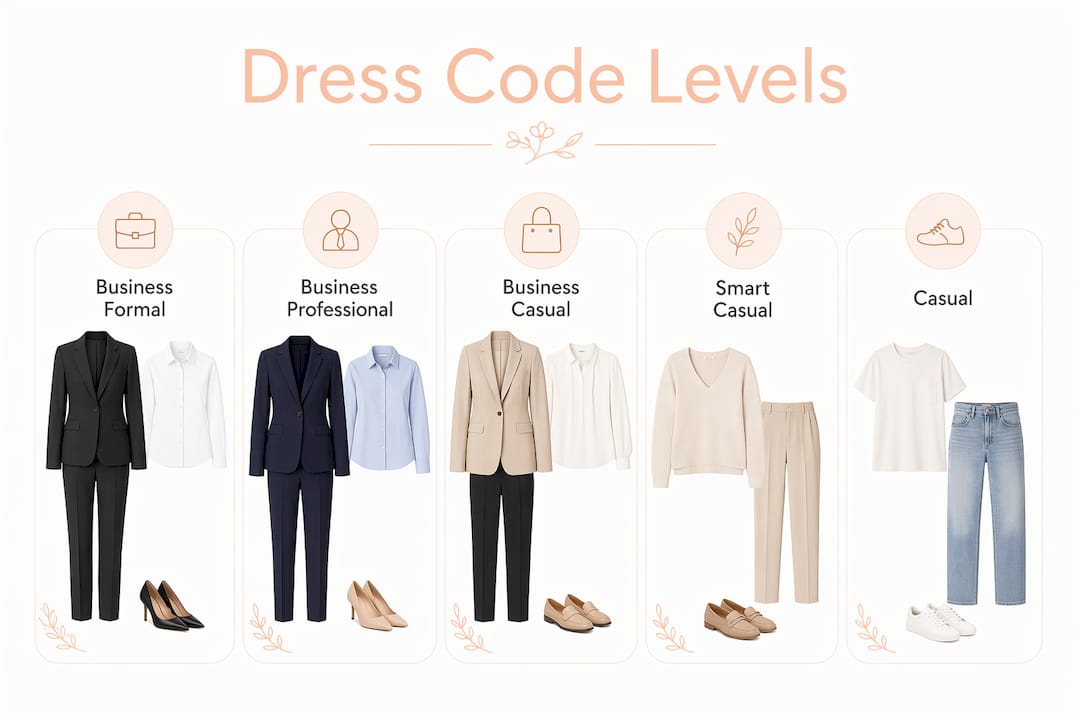
Women’s attire follows a formal-to-casual hierarchy with five core professional categories and two primary social event codes. Each level has distinct expectations around fabric, silhouette, and footwear. Knowing where each code sits on that spectrum is the foundation of dressing well.
Business Formal is the most elevated professional standard. Think tailored suits in wool or crepe, silk blouses, and closed-toe heels. This code applies to C-suite environments, courtrooms, and high-stakes client presentations.

Business Professional sits one step below. It covers client-facing roles in finance, law, and consulting. Structured blazers, tailored trousers, sheath dresses, and modest heels or polished flats all qualify.
Business Casual is the most misunderstood category in women’s dress code rules. Business casual requires tailored pieces and excludes athletic shoes, ripped denim, and graphic tees. Polished trousers, blouses, midi skirts, and optional blazers are the standard. It is not an invitation to dress down.
Smart Casual is common in startups, creative agencies, and tech companies. Dark jeans with a structured top, a midi dress with ankle boots, or tailored chinos with a blazer all work here.
Casual applies to informal settings where comfort leads. Even here, clean, well-fitting clothes signal self-awareness.
For social events, Black Tie requires floor-length gowns in silk or satin, while Cocktail or Semi-Formal calls for knee-to-midi length dresses in elegant fabrics. Midi-length dresses are among the most versatile pieces you can own, crossing from professional to social settings with ease.
| Dress Code | Key Pieces | Fabrics | Footwear | Occasion |
|---|---|---|---|---|
| Business Formal | Tailored suit, silk blouse | Wool, crepe, silk | Closed-toe heels | C-suite, courtrooms |
| Business Professional | Blazer, sheath dress | Structured wovens | Heels or polished flats | Client meetings |
| Business Casual | Trousers, blouse, midi skirt | Cotton, ponte | Loafers, low heels | Most offices |
| Smart Casual | Dark jeans, structured top | Mixed fabrics | Ankle boots, clean sneakers | Startups, creative roles |
| Black Tie | Floor-length gown | Silk, satin | Heeled sandals or pumps | Galas, formal events |
Pro Tip: Add a “third piece” to any outfit. A blazer, structured cardigan, or statement shoe instantly moves an outfit one level up the formality scale without a full wardrobe change.
What legal and social norms say about women’s dress codes
Legal frameworks directly shape what employers can and cannot require women to wear. Dress codes requiring skirts or heels for women are considered discriminatory and legally risky in many jurisdictions. The principle is straightforward: dress codes must not impose greater burdens on one gender than another.
The legal standard matters even if you work in a country without the Equality Act 2010. Most Western employment law follows the same logic: dress code policies must be job-relevant, applied consistently, and free of gender-based cost or time burdens. Employers who ignore this face real legal exposure.
Beyond the law, women face a layer of unwritten expectations that no policy document covers:
- The polish standard. Grooming and composure count as much as clothing in professional credibility. Women invest 30–45 minutes daily on grooming to meet this unspoken standard. That is a significant invisible time cost that men rarely face at the same level.
- The authority balance. Women are expected to appear approachable but authoritative, feminine but not distracting. This hidden dress code requires calibrating presence in ways that have no male equivalent.
- Global variation. Dress code enforcement differs sharply by country and industry. A business casual standard in New York reads differently in Tokyo or Dubai. Cultural context always layers on top of the written policy.
Pro Tip: When a dress code policy feels vague or unfair, focus on objective outcomes: safety, professionalism, and role relevance. That framing helps you push back on unreasonable requirements with a clear, defensible position.
Styling strategies that make dress codes easier to follow
A capsule wardrobe is the most practical tool for navigating multiple dress codes without decision fatigue. The concept is simple: a small collection of high-quality, coordinated pieces that work across many outfits and settings. A 70% neutral and 30% accent color split gives you maximum mix-and-match flexibility while keeping your wardrobe visually cohesive.
Fit and fabric are the two variables that matter most. A well-fitted ponte trouser reads as business casual. The same silhouette in jersey knit reads as casual. Structured fabrics, including wool blends, crepe, and woven cotton, signal formality. Soft, stretchy fabrics signal comfort. Choosing the right fabric for the setting is half the battle.
Here are the core pieces that cover the widest range of dress codes:
- A tailored blazer in navy, black, or camel
- Two to three silk or woven blouses in neutral tones
- A midi skirt in a solid color or subtle print
- Tailored trousers in black and one neutral
- A sheath dress or wrap dress that works for professional and social settings
- One pair of polished flats and one pair of low heels
- A structured bag that works from desk to dinner
These wardrobe essentials form the backbone of a dress code-ready closet. You build on them with seasonal pieces and accessories rather than starting from scratch each time.
Transitions between settings are where most women struggle. The fix is usually one swap. Add a blazer over a blouse-and-trouser combination to move from business casual to business professional. Swap flats for heels and add a statement necklace to move from office to cocktail event. The core outfit stays the same. The context shifts with the accessories.
Pro Tip: Invest in classic wardrobe staples that hold their shape and color after repeated wear. Cost-per-wear on a quality blazer is far lower than replacing cheap versions every season.
How to read ambiguous or evolving dress codes
Vague dress codes are the norm, not the exception. Most invitations and employee handbooks use terms like “smart casual” or “business appropriate” without defining them. Leaning toward formality is the safest default. Overdressing is far more socially accepted than underdressing in professional and social contexts.
Your role within an organization also shapes the real dress code expectation. Client-facing roles demand higher formality than back-office or internal roles, regardless of what the written policy says. A marketing analyst and a client relationship manager at the same company may follow very different unwritten standards.
Company culture and geography add another layer. A financial services firm in Chicago operates differently from a design studio in Austin. Hybrid work has blurred lines further, with many women now dressing for video calls rather than in-person offices. The camera frame matters: your top half needs to read as polished even when the rest of your outfit does not.
Use this table to decode context clues when the dress code is unclear:
| Context Clue | What It Signals | Suggested Approach |
|---|---|---|
| Formal venue (hotel ballroom, law firm) | High formality expected | Business professional or above |
| Creative office, open floor plan | Smart casual or business casual | Structured top, clean denim acceptable |
| Invitation says “cocktail attire” | Semi-formal social event | Knee-to-midi dress, elegant fabric |
| Client-facing first meeting | Err formal regardless of company culture | Business professional minimum |
| Hybrid video call | Upper half visible only | Polished blouse or blazer, neutral tones |
Social cues matter as much as written guidance. The venue, the host’s industry, and the guest list all communicate expectations. A rooftop party hosted by a tech company reads differently from a dinner hosted by a law firm, even if both invitations say “casual.”
Key takeaways
Dress codes for women operate on a formal-to-casual spectrum, and knowing where each setting falls gives you the confidence to dress right every time.
| Point | Details |
|---|---|
| Dress code hierarchy | Five professional levels exist, from Business Formal to Casual, each with distinct fabric and footwear standards. |
| Legal protections | Dress codes cannot impose gender-specific burdens; policies must be job-relevant and applied equally. |
| Invisible labor is real | Women spend 30–45 minutes daily on grooming to meet unspoken polish standards, a cost worth acknowledging. |
| Capsule wardrobe wins | A 70% neutral, 30% accent color palette covers most dress codes with minimal pieces. |
| Default to formality | When a dress code is unclear, dressing one level up is always the safer and more respected choice. |
The dress code conversation nobody is having
I’ve spent years watching women tie themselves in knots over dress codes, and the thing that strikes me most is how much of the burden is invisible. The written policy says “business casual.” What it actually means, for women, is: look polished, look approachable, look authoritative, and do it all without standing out for the wrong reasons. That is a genuinely different assignment than what most men face.
The invisible polish standard is real. Blazers and structured clothing give women a shortcut to credibility that softer fabrics simply do not. That is not a fashion opinion. It is a social reality backed by how people read authority in professional spaces.
What I’d push back on is the idea that dressing for dress codes means suppressing your style. The women I’ve seen navigate this best treat the dress code as a floor, not a ceiling. They meet the standard and then express themselves within it through color, texture, accessories, and fit. That approach builds confidence and makes getting dressed feel less like a compliance exercise.
The mindset shift that matters most: stop dressing defensively. Dress for the role you want, the room you’re walking into, and the impression you choose to make. Dress codes are a framework. You decide what you build inside it.
— Patrick
Build a dress code-ready wardrobe with Wildflowerwardrobe
Understanding dress code guidelines for women is only half the work. Having the right pieces in your closet makes the rest automatic.
Wildflowerwardrobe carries a curated selection of versatile women’s clothing designed to work across casual and business casual settings without sacrificing personal style. From polished everyday pieces to statement accessories, the collection is built for women who want to dress well without overthinking it. Browse the women’s casual wear collection for wardrobe-building essentials that cross settings with ease. Complete your look with pieces from the jewelry collection to add the finishing detail that takes any outfit from adequate to polished.
FAQ
What is a dress code for women?
A dress code for women is a set of explicit or implicit rules that define acceptable attire for a specific environment or occasion. These rules vary by setting, from Business Formal in corporate offices to Cocktail attire at social events.
What does business casual mean for women?
Business casual excludes ripped clothing, graphic prints, and athletic shoes, favoring polished trousers, blouses, and optional blazers. Proper fit and fabric quality are what separate business casual from everyday casual wear.
Can a workplace legally require women to wear heels or skirts?
Dress codes that require heels or skirts specifically for women are considered discriminatory and legally risky in many jurisdictions. Policies must be job-relevant and must not impose greater burdens on one gender than another.
How do you dress when the dress code is unclear?
Lean toward formality when a dress code is vague, since overdressing is more socially accepted than underdressing. Use venue, host industry, and event type as context clues to calibrate your choice.
What is the easiest way to build a dress code-ready wardrobe?
A capsule wardrobe built on a 70% neutral color palette covers most dress codes with minimal pieces. Focus on tailored blazers, midi skirts, structured trousers, and versatile dresses that move between professional and social settings.
Recommended
- Seasonal Clothing Checklist for Women: Season-by-Season Guide – Wildflower Wardrobe
- Common Wardrobe Mistakes Women Make (and How to Fix Them) – Wildflower Wardrobe
- Everyday wardrobe essentials women need for stylish versatility – Wildflower Wardrobe
- The Real Role of Undergarments in Outfits – Wildflower Wardrobe
0 comments