

Few fabrics have earned their place in fashion the way denim has. The role of denim in classic wardrobes goes far beyond weekend wear or a casual fallback. It’s a foundational fabric with a 150-year track record of cultural relevance, structural durability, and surprising versatility. Most people treat denim as disposable, swapping cheap pairs every season, when the opposite approach actually produces better style and better value. This guide breaks down what makes denim truly classic, how to select pieces that last, and how to wear them with intention across every season and occasion.
Table of Contents
- Key Takeaways
- The role of denim in classic wardrobes starts with history
- What makes a denim piece actually classic
- How to style denim for timeless, versatile outfits
- Building a denim collection that actually lasts
- My honest take on denim as a wardrobe investment
- Denim staples worth wearing every day
- FAQ
Key Takeaways
| Point | Details |
|---|---|
| Denim is a wardrobe foundation | Its durability and versatility make it one of the most reliable classic clothing items across decades. |
| Fabric weight shapes longevity | Midweight denim (~12-14 oz) offers the best year-round balance of structure and wearability. |
| Classic fits outlast trends | Straight, slim straight, and bootcut silhouettes remain the most wearable and timeless denim styles. |
| Own fewer, better pieces | Two to three high-quality denim items outperform a closet full of cheap, shapeless alternatives. |
| Proportions define the outfit | Pairing wide-leg cuts with fitted tops or slim jeans with structured shoes creates balanced, polished looks. |
The role of denim in classic wardrobes starts with history
Denim did not begin as fashion. It began as a solution. In the 1870s, Levi Strauss and Jacob Davis created riveted denim trousers for California gold miners who kept destroying their pants under physically brutal conditions. The fabric, a sturdy cotton twill woven in Nîmes, France (hence “de Nîmes”), was chosen purely for its ability to hold up.
That origin story explains everything about why denim became a classic. It was built to survive, not to impress. And yet, by surviving generation after generation, it earned something far more valuable than trendiness. It earned trust.
The cultural evolution from workwear to wardrobe staple happened in stages:
- 1940s and 1950s: Hollywood introduced denim as the fabric of rebellion and individualism, with Marlon Brando and James Dean making jeans look effortlessly cool.
- 1960s and 1970s: Denim became a symbol of counterculture, freedom, and self-expression across gender lines.
- 1980s and 1990s: Designer denim arrived, with labels charging premium prices for what had once been factory wear. The idea of denim as an investment was born.
- 2000s to present: Denim fashion staples settled into their current role as genuine wardrobe essentials worn across every income bracket, age group, and cultural context.
“Denim is the one fabric that has successfully crossed every social and sartorial boundary. It belongs equally to the ranch and the runway.” — Fashion historian Anne Hollander
The reason denim stayed relevant across all those shifts is the same reason it was invented in the first place: durability. A fabric that physically lasts also lasts culturally. Understanding that history reshapes how you shop. Every quality denim piece you buy is part of a long, ongoing tradition of wearing something built to endure.
What makes a denim piece actually classic
Not all denim qualifies as a wardrobe essential. The word “classic” carries real criteria, and denim meets them only when the fabric, fit, wash, and construction align.
Fabric weight and composition
Midweight denim at 12-14 oz offers the best balance between durability and comfort for year-round wear. Lighter weights (under 10 oz) feel great in summer but often lose their shape quickly. Heavier denim (15+ oz) delivers impressive longevity and structure, but it’s stiff and difficult to wear in warmer months.
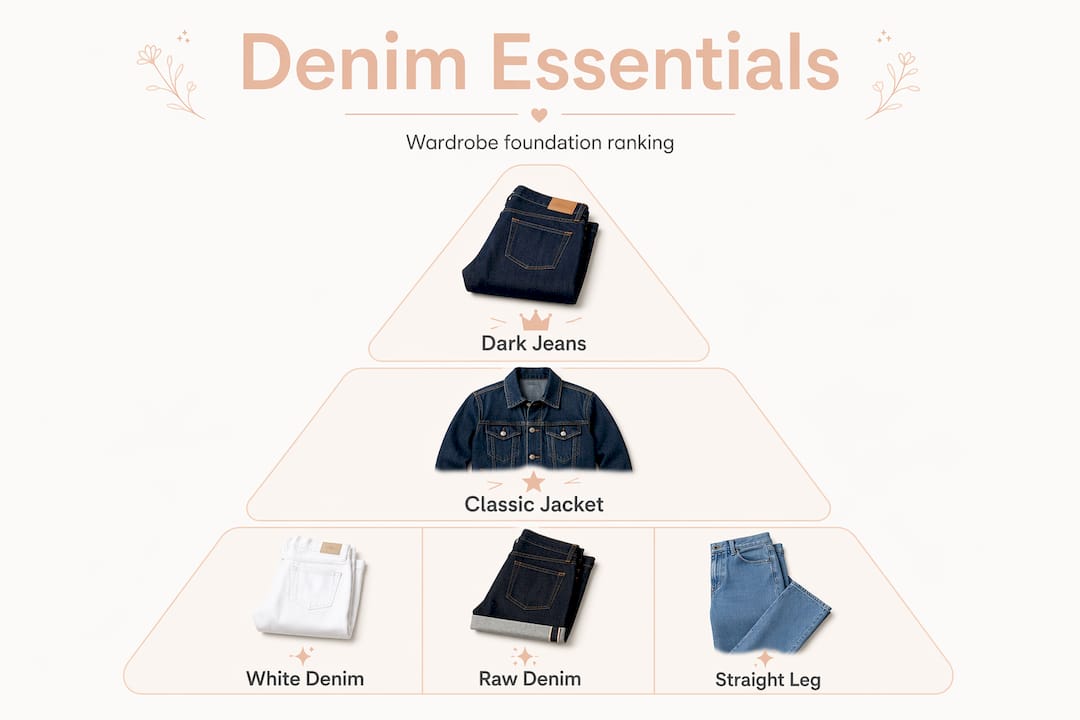
Raw denim, which is unwashed and untreated, molds to your body over time and develops a personalized wear pattern. Washed denim comes broken in and ready to wear. Stretch denim with a small percentage of elastane (2-4% maximum) improves comfort without compromising the garment’s structure. Beyond that percentage, the shape and drape typically suffer.
Classic fits worth knowing
| Fit | Silhouette | Best worn with |
|---|---|---|
| Straight leg | Consistent width from hip to hem | Almost anything; the most versatile cut |
| Slim straight | Fitted through thigh, straight below knee | Structured shoes, blazers, tailored tops |
| Cigarette | Close-fitting throughout | Heels, loafers, cropped jackets |
| Bootcut | Slight flare at hem | Boots, wide-belt styling |
| Wide leg | Relaxed through hip and leg | Fitted or tucked tops, flat shoes |
Washes that age well
Dark indigo is the most dependable wash for classic wardrobes. Dark indigo denim in 2026 bridges casual and smart-casual contexts with equal ease. Classic mid-blue reads as relaxed and approachable. Black denim occupies a category of its own, pairing cleanly with almost every color.
Avoid heavily distressed or overly faded denim if longevity is the goal. Those finishes look dated quickly and are harder to style outside a narrow set of occasions.
Construction markers that signal quality
Chain stitching, lock stitching, and bar tacks are the hallmarks of genuinely well-made denim. Check the stitching at stress points: pockets, belt loops, and inseams. Selvedge denim, woven on traditional narrow looms, shows a clean finished edge on the inside of the fabric and typically indicates higher-grade production. Quality hardware (rivets, zippers, buttons) that resists corrosion is also a reliable signal.
Pro Tip: Turn your denim inside out to inspect stitching before buying. Uneven or skipped stitches are early warning signs of premature wear.
How to style denim for timeless, versatile outfits
Styling is where denim’s flexibility becomes either an asset or a source of confusion. The key is understanding proportion and context. Once you have those two variables locked in, timeless denim outfits essentially assemble themselves.
-
Match width with its opposite. Stylists recommend pairing baggy or wide-leg jeans with fitted tops. The contrast in volume creates a balanced silhouette rather than an overwhelming one. Slim cuts work in reverse: structured, slim-fitting footwear and a slightly relaxed top complete the proportional balance.
-
Use dark denim to dress up. A dark indigo or black pair of jeans with clean lines reads as smart-casual when paired with a blazer and leather loafers. Darker denim washes carry higher perceived polish and open up more styling options across social contexts.
-
Layer for seasonal versatility. Denim in everyday wear earns its keep year-round when you adjust what goes on top. A light chambray shirt in summer, a classic white tee in early fall, a structured wool coat in winter. The denim stays constant; the layers carry the season.
-
Keep color coordination intentional. Tonal denim looks (top and bottom in similar blue shades) create a confident, editorial feel when done with purpose. For a boundary-pushing approach, pair chambray blue denim with earthy camel tones, burgundy, or forest green. Avoid pairing two contrasting patterned pieces with denim, since denim works best as the neutral anchor in an outfit.
-
Treat footwear as the outfit’s punctuation. White leather sneakers keep denim casual and fresh. Ankle boots add edge and elongate the leg. Pointed-toe flats or loafers pull denim into a polished register. The shoe choice signals the occasion more than almost any other variable in a denim outfit.
Pro Tip: When styling denim in everyday wear for work, choose your shoe first. A polished shoe will do more to elevate the outfit than any amount of accessorizing.
Building a denim collection that actually lasts
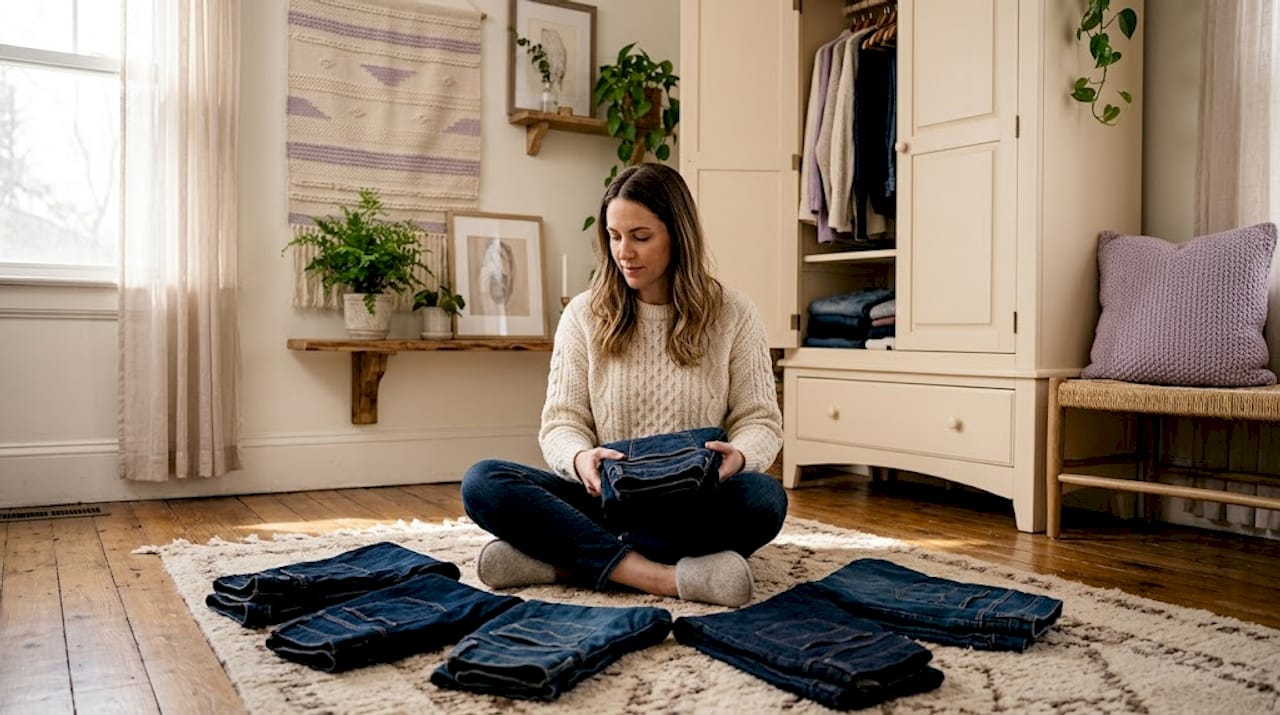
The smartest denim wardrobes are small on purpose. Fashion experts recommend owning only 2-3 high-quality denim pairs rather than accumulating a dozen mediocre ones. The reasoning is straightforward: investment pieces hold their shape longer, require fewer replacements, and create a more consistent foundation for getting dressed.
Here’s what a focused denim collection looks like in practice:
- One dark indigo straight or slim-straight pair for smart-casual and dressed-up contexts
- One classic mid-blue relaxed or wide-leg pair for casual everyday wear
- One black denim option (jeans or a jacket) for evening and transitional styling
That’s it. Three pieces cover virtually every context denim belongs in, without the decision fatigue that comes from owning seven pairs you never quite know how to wear.
Sizing and fit: getting it right from the start
Vanity sizing and fabric stretch make it nearly impossible to rely on the tag. The most reliable method is to measure a pair of jeans you already own and compare those measurements directly against a brand’s size chart. Focus on the waist flat measurement, hip measurement, and inseam length. Rise matters too: a high rise typically suits wide-leg and relaxed cuts, while mid-rise works well with straighter silhouettes.
Caring for denim to preserve it
Washing denim inside out in cold water and air-drying preserves both the color and the fabric structure. Avoid fabric softeners, which break down cotton fibers over time. Wash as infrequently as the fabric allows. Many denim purists spot-clean and air out their jeans between wears, reserving machine washing for genuine necessity.
The environmental argument for fewer, better denim pieces is real. The fashion industry’s denim production is water-intensive, and the fastest way to reduce that footprint is to buy less and buy better. A well-cared-for pair of quality jeans can last a decade. That math changes how you think about the $150 price tag versus the $40 alternative.
A trend-proof wardrobe checklist can help you assess which denim gaps actually exist in your closet before you buy anything new.
My honest take on denim as a wardrobe investment
I used to buy cheap denim constantly. I thought I was being practical, picking up whatever fit decently and cost less than the mortgage on a small country. What I actually did was waste money at scale, because a pair that costs $35 and falls apart in eight months costs more per wear than a $180 pair I wore for six years.
The shift that changed my thinking was simple: I started treating denim the way I treated leather shoes. Something worth caring for, worth fitting properly, and worth owning in a small number of excellent versions rather than a large pile of acceptable ones. Once that mental frame clicked, I stopped feeling the pull of every seasonal denim trend and started recognizing the classic wardrobe staples that would actually serve me year after year.
The mistake most people make with denim is trying to buy versatility cheaply. It doesn’t work. Versatility in denim comes from quality of construction, consistency of wash, and precision of fit. None of those things are available at bargain bin prices. What you get there is a garment that gives up after a year and takes a small piece of your confidence with it.
Denim rewards patience and intention. Give it those two things, and it gives back more than almost any other fabric in your wardrobe.
— Patrick
Denim staples worth wearing every day
Building a timeless wardrobe starts with choosing pieces that actually work harder than your schedule demands. At Wildflowerwardrobe, the focus has always been on curating denim and casual wear that balances modern styling with lasting quality.
The Judy Blue High Rise Ankle Wide Leg Jeans deliver the high-rise, wide-leg silhouette that stylists consistently recommend for balanced, polished denim outfits. If you want to add a classic denim layer to your rotation, the RISEN classic denim jacket is a strong starting point. For a broader look at what rounds out a timeless everyday wardrobe, the full women’s casual wear collection at Wildflowerwardrobe includes pieces specifically selected for their versatility, quality, and styling range. Every piece is chosen with the same principle this article is built on: buy less, choose well, wear it for years.
FAQ
What is the role of denim in a classic wardrobe?
Denim serves as one of the most versatile foundation pieces in a classic wardrobe, bridging casual and smart-casual contexts across seasons and occasions when chosen in quality cuts and classic washes.
How many pairs of jeans should I own?
Fashion experts recommend owning 2-3 high-quality pairs rather than accumulating many cheaper alternatives. A dark indigo, a mid-blue, and a black option cover nearly every styling context.
Which denim wash is the most timeless?
Dark indigo is widely regarded as the most flexible and enduring wash, offering polished versatility across casual and dressed-up settings without dating quickly.
How do I find my correct denim size?
Skip the tag and instead measure a well-fitting pair you already own, then compare those measurements directly to the brand’s size chart to account for vanity sizing and fabric stretch.
What denim weight works best year-round?
Midweight denim at 12-14 oz offers the ideal balance between durability and comfort, making it the most practical choice for wearing denim across all four seasons.
0 comments