

Digital fashion styling is the process of designing and assembling virtual clothing using 3D software and AI to create realistic digital outfits that can be layered, fitted, and rendered on digital avatars. The industry term for this practice is “virtual fashion styling,” though “digital fashion styling” is now the standard phrase used across retail and design platforms. The process covers everything from garment digitization and avatar body mapping to AI-driven outfit curation and fabric physics simulation. Understanding how digital fashion styling works gives aspiring stylists a real edge, whether they plan to work in e-commerce, editorial, or the growing space of virtual fashion.
How does the digital fashion styling process work?
Digital fashion styling combines three core systems: 3D garment modeling, virtual avatar fitting, and AI-powered outfit curation. Each system feeds into the next, creating a workflow that is faster and more flexible than traditional studio styling. Digital styling reduces outfit creation time from 60–120 minutes per look to roughly 10 minutes using avatars and AI. That speed shift changes what is possible for small teams and solo stylists working at scale.
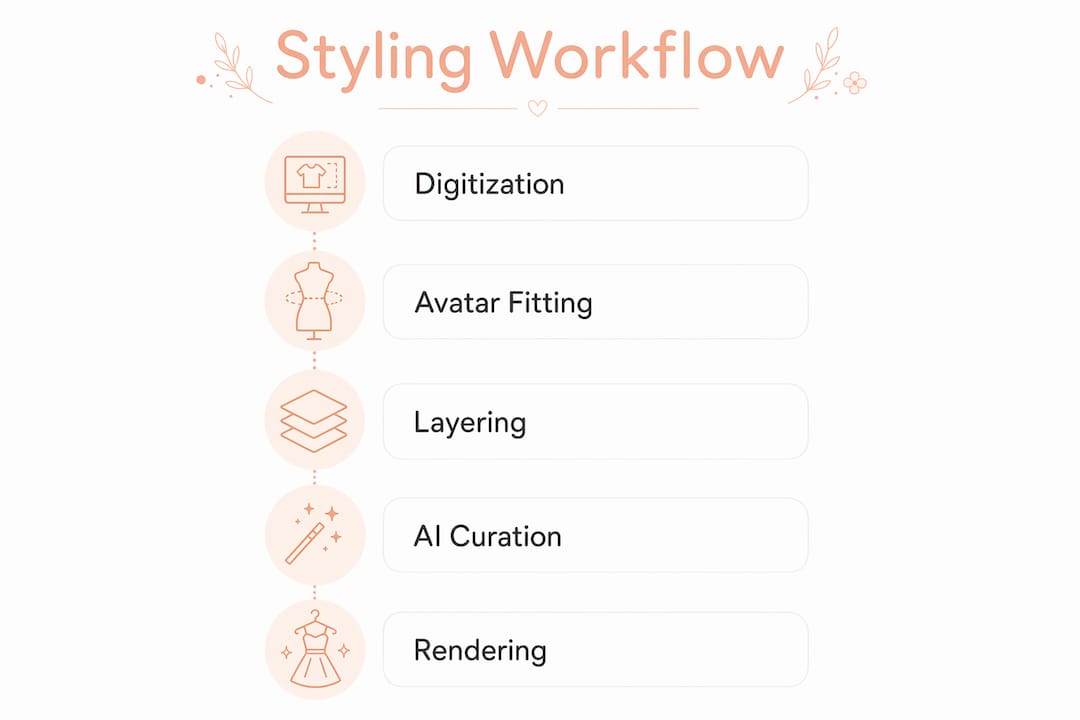
The workflow starts with raw garment data, moves through avatar fitting and layering logic, and ends with a rendered image or interactive try-on. AI algorithms run throughout, tagging attributes, scoring outfit combinations, and flagging poor matches before a human reviewer ever sees the result. The final output can be a lookbook image, a product page photo, or a live virtual try-on experience for shoppers. Each step builds on the last, so understanding the full chain matters.

How are digital garments created and prepared for styling?
Garment digitization is the foundation of every virtual styling workflow. A physical or conceptual garment gets translated into a 3D model with accurate geometry, surface texture, and material data. The model must carry information about fabric weight, stretch, and drape before it can behave realistically in a simulation.
The digitization process typically follows these steps:
- Geometry modeling: A designer builds the garment’s shape using polygon meshes, defining seams, panels, and silhouette.
- Texture mapping: Surface details like weave patterns, prints, and sheen are applied as image layers onto the 3D model.
- Material parameter assignment: Fabric physics values, including weight, stiffness, and elasticity, are set so the simulation engine knows how the cloth will move.
- Digital twin creation: The finished asset becomes a digital twin, a virtual replica that behaves like the real garment under gravity and motion.
- AI-assisted attribute tagging: AI tools scan the model and extract style attributes such as color family, occasion suitability, and garment category for use in outfit curation later.
AI-assisted digitization tools now automate much of the attribute extraction step, which previously required manual tagging by merchandising teams. That automation cuts preparation time significantly and reduces human error in large catalogs.
Pro Tip: Start garment digitization with accurate real-world measurements. Even small errors in the base mesh create compounding fit problems once the garment is placed on an avatar.
What role do virtual avatars play in digital fashion styling?
Virtual avatars replace physical models and studio fittings in the digital styling workflow. An avatar is a 3D body model built from measurements, body scans, or standardized size chart data. It holds the garment in place and simulates how fabric behaves on a real human body.
Avatar customization follows a clear sequence:
- Input body data. Measurements, 3D body scans, or size chart profiles define the avatar’s proportions.
- Build the base mesh. A dense polygon wireframe wraps the avatar’s body, creating the surface that garments will interact with.
- Apply Dense Mesh technology. Dense Mesh construction wraps a detailed 3D wireframe around the avatar, enabling fabric physics simulation for accurate drape depending on material type. This is what separates realistic virtual fitting from a flat image overlay.
- Set pose and motion parameters. The avatar can be posed statically or animated to show how garments move during walking or turning.
- Test garment fit. The styled garment is placed on the avatar and the simulation engine runs, revealing how the fabric drapes, stretches, and sits at key points like shoulders, waist, and hem.
Avatar diversity matters in digital styling because fit accuracy depends on body shape variation. A garment that fits well on a single standard avatar may show fit problems on a curvier or taller body model. Professional styling workflows use multiple avatar body types to catch these issues before a product goes live. This step directly reduces return rates for online retailers, since shoppers get a more accurate preview of how a piece will look on their body type.
How does layering and collision logic enable realistic outfit assembly?
Digital layering is not simply stacking garment images on top of each other. Digital layering workflows assign numerical collision priorities to garments, ensuring realistic stacking and preventing mesh clipping in virtual outfits. Clipping occurs when two garment meshes overlap visually, making fabric appear to pass through fabric. Collision logic prevents this automatically.
Garments are organized into three categories based on their position on the body:
| Layer category | Examples | Collision role |
|---|---|---|
| Innerwear | Bra, tank top, slip | Hugs the body mesh; lowest priority number |
| Mid-layer | Shirt, blouse, sweater | Sits over innerwear; mid-range priority |
| Outerwear | Blazer, coat, jacket | Pushes all layers beneath it; highest priority |
A typical layering stack runs: tank top → fitted shirt → blazer → overcoat. Each garment in the stack carries a collision priority number. When the simulation runs, higher-priority garments push lower-priority ones outward, creating natural volume and drape. Logic gates automate this interaction, so a stylist does not need to manually adjust every layer when swapping pieces.
Pro Tip: When building a layered look digitally, always assign collision priorities before running the simulation. Fixing clipping after the fact takes far longer than setting the hierarchy correctly from the start.
How do AI algorithms assist in digital fashion styling and outfit curation?
AI in digital fashion styling works as both a tagger and a curator. The process starts with attribute extraction, where AI reads each garment’s color, silhouette, occasion tag, and style vibe from its digital asset data. These attributes form a style profile for every item in a catalog.
The curation process then works like this:
- Style fingerprinting: The AI builds a compatibility map based on color theory rules, occasion matching, and aesthetic categories.
- Outfit generation: The algorithm selects garments from the catalog that score well against each other’s style profiles.
- Scoring and evaluation: Each generated outfit receives a quality score based on color harmony, wearability, and occasion fit.
- Iterative refinement: AI evaluation systems flag low-scoring outfits and regenerate combinations until quality thresholds are met. This loop is what separates professional AI styling from basic recommendation engines.
- Human review: A merchandising team or stylist reviews the top-scoring outfits, corrects any mismatches, and approves the final selections.
“The evaluation system in AI styling, with feedback loops filtering out poor combinations, is more critical than generation alone for high-quality results. AI that generates without evaluating produces volume, not quality.”
Gartner analysts project that AI style agents using multimodal AI to process images and text simultaneously will become primary fashion discovery interfaces by 2028. That projection signals how central AI curation is becoming to the entire styling industry, not just e-commerce.
A hybrid workflow where AI handles bulk attribute extraction and humans review the outputs is the current standard for scaling digital styling quality while maintaining brand alignment. Neither AI alone nor human-only review matches the speed and accuracy of the combined approach.
What technologies enable realistic virtual try-on experiences?
Virtual try-on is the consumer-facing output of the digital styling process. The technology behind it involves four distinct stages, each building on the last to create a lifelike result.
- Pose estimation. Computer vision algorithms detect the person’s body position in a photo or video using skeletal keypoint detection. Standard 2D systems map 68 body points to establish pose.
- Dense mesh mapping. Advanced engines replace the 68-point skeleton with a full 3D surface map. Advanced virtual try-on engines process 1.4 million polygons per second using Gravity Mesh technology, compared to the 68 points used in basic 2D filters. That difference in polygon density is what makes fabric look like fabric rather than a flat sticker.
- Fabric physics simulation. The garment mesh is warped and draped over the body surface using material parameters set during digitization. Heavy fabrics like denim fall differently than silk or jersey, and the simulation reflects those differences.
- Final compositing. The draped garment is rendered with lighting, shadows, and edge blending to match the background image. The result integrates the virtual garment into the original photo in under 3 seconds on current-generation platforms.
The speed of this pipeline matters for retail. Shoppers who can see a garment on a body that resembles their own are more likely to complete a purchase and less likely to return it. Understanding online clothing shopping behavior shows that visual confidence at the point of decision is the single biggest driver of conversion in fashion e-commerce.
Key Takeaways
Digital fashion styling works because it combines 3D garment modeling, avatar-based fitting, collision-priority layering, AI curation, and physics-based rendering into a single connected workflow.
| Point | Details |
|---|---|
| Garment digitization is the foundation | Every virtual styling workflow starts with accurate 3D models carrying fabric physics data. |
| Avatar diversity improves fit accuracy | Using multiple body-type avatars catches fit problems before products go live. |
| Collision priority prevents clipping | Numerical layer rankings automate realistic garment stacking without manual fixes. |
| AI evaluation beats AI generation alone | Iterative scoring loops filter poor outfits and raise overall styling quality. |
| Polygon density defines try-on realism | Processing 1.4 million polygons per second creates fabric behavior that 68-point 2D systems cannot match. |
Why the human stylist still sets the ceiling
I have watched a lot of stylists hand their entire creative process over to AI tools and then wonder why every output looks the same. The algorithm is not the problem. The problem is that they never gave it a real style fingerprint to work from.
Human creative input defines a “style fingerprint” that keeps AI-generated styling visually unique and prevents generic outputs. Without that input, AI defaults to statistically average combinations. Average is not a brand identity.
The workflow habit I recommend is big to small: establish the overall silhouette and color story before touching individual garments. Starting with rough shape and lighting blocks before garment details prevents creative burnout and keeps the workflow moving forward. Stylists who jump straight to accessory selection without a clear color direction waste hours backtracking.
The other mistake I see constantly is skipping the merchandising review step. AI will generate technically correct outfits that are commercially wrong, pairing a formal gown with casual sneakers because both scored well individually. Human review catches those mismatches. The fashion forecasting process also feeds directly into this review stage, since trend awareness is something AI cannot fully replicate from catalog data alone.
Digital styling tools are genuinely powerful. They are also only as good as the creative direction you give them.
— Patrick
What Wildflowerwardrobe offers for your digital styling practice
Digital styling principles work best when you have real pieces worth styling. Wildflowerwardrobe curates a collection of women’s fashion designed for exactly the kind of mix-and-match thinking that digital styling teaches.

The women’s casual wear collection at Wildflowerwardrobe gives you versatile layering pieces that translate directly from digital lookbooks to real-world outfits. Statement accessories like the Fame Multi Belt Strap Shoulder Bag and pieces from the jewelry collection round out looks the same way digital stylists use accessories to finish an outfit stack. Every piece is selected to work across multiple styling contexts, which is the same principle that makes digital wardrobe management effective.
FAQ
What is digital fashion styling?
Digital fashion styling is the process of creating and assembling virtual outfits using 3D garment models, virtual avatars, and AI curation tools. It produces styled looks for e-commerce, editorial, and virtual try-on applications without physical garments or studio shoots.
How long does digital styling take compared to traditional styling?
Digital styling reduces outfit creation from 60–120 minutes to approximately 10 minutes per look using 3D avatars and AI. Model shot generation on current platforms takes 10–60 seconds.
What is collision priority in digital layering?
Collision priority is a numerical ranking assigned to each garment layer that tells the simulation engine which garments push outward and which hug the body. It prevents mesh clipping and creates realistic fabric volume automatically.
How does virtual try-on technology work?
Virtual try-on uses pose estimation, dense mesh body mapping, fabric physics simulation, and final compositing to place a digital garment realistically onto a photo or avatar. Advanced engines process up to 1.4 million polygons per second to simulate accurate fabric behavior.
Do I need AI tools to practice digital fashion styling?
AI tools accelerate attribute tagging and outfit curation, but the core workflow of garment modeling, avatar fitting, and layering logic can be practiced without them. AI adds speed and scale; human creative direction adds quality and brand identity.
0 comments